Thursday, July 23, 2020

When No Real Locale Will Serve

Stephen King has Castle Rock, Maine.
Scott Turow has Kindle County, Illinois.
William Faulkner had Yoknapatawpha County, Mississippi.
And I have Onteora County, New York.

     There are no such places, of course. Yet quite a lot of interesting stuff – headline-making, really – happens in each of them. I have no idea whether King, Turow, or Faulkner’s ghost is ever asked this, but one of the questions I get most frequently from readers of my fiction is “Why did you have to invent a fictional county to site your stories in?”

     Well, sometimes no real place will serve. Sometimes the general knowledge readers bring to the fiction they select is just too great – too likely to undermine what every storyteller must get from his readers: the willing suspension of disbelief. I know I’d be lost without it, because of the strangeness of my tales and the larger-than-life heroes I prefer to depict.

     It’s best to avoid the use of real places if your aim is to speak of world-class intellects and men of unprecedented moral courage. There’s a shortage of both varieties. The problem intensifies if you intend to create a whole lot of them – which I did.

     In part this is an aspect of the prevailing cynicism: the “people just aren’t like that” / “no real person would take such risks or make such sacrifices” attitude that’s endemic to our time. Yet it’s my firm conviction that people need heroes. We need to admire their deeds and hope someday to rise to their level. It’s why good parents still tell the great myths of Greek legend to their youngsters...and why far too many youngsters who never hear a heroic story grow up admiring sports figures and entertainers.

     But if you need a place where a gaggle of heroes can germinate and blossom into national or global stature, a fictional place will probably serve you better than any real locale.

     There are variations on this practice that ought to be compared. For example, consider the current trend in romance toward the employment of a very rich male co-protagonist: a multimillionaire or billionaire. There are a slew of such books out there, and from what I can determine they’re very popular. Yet how many ultra-rich persons are there really, and how many of them make it into their thirties and forties without being securely mated, pre-nuptial agreements and all, and thus romance-proof?

     I’ve used that motif too. However, I “flipped the script” in my short romance Love in the Time of Cinema, by making the girl the multimillionaire. That’s certainly a valid approach...but candidly, it’s even less realistic than the prevailing tendency, in which the male protagonist is the rich one. (“You can’t do anything the usual way, can you?” – my wife. Heh, heh, heh! Just wait till she reads Love in the Time of Capitalism!)

     Of course, the “extreme” pole of this practice occurs in the outright speculative genres of fantasy (The Warm Lands), science fiction (Which Art In Hope), and horror. Some things require whole new worlds – even whole new universes. That’s the case when you want to break a few of the laws of physics, not just those of Congress. And once again, the great ones, the Tolkiens and Benfords, do what they must to make it work.

     As I wrote above, it’s about the willing suspension of disbelief: getting the reader to accept the premises of the story. If you can’t win that from him, he won’t get full value from your tale. But this is a special case of the much larger subject of the rules of storytelling: doing what you must do to please the reader with the tale you hope to stell him. Ultimately, that’s the one and only absolute rule. All the others are useful guidelines. The aspiring writer must absorb and respect them, but as he matures he will learn that each of them, like all rules for doing anything practical, has a proper domain of application. Outside that domain – the regions on the storyteller’s map marked “Here there be dragons” in Gothic Blackscript – he may sometimes set them aside to his advantage.

     If he has a hero’s courage, that is. For that, too is an essential of the good storyteller. Why else would it be “To boldly go where no man has gone before,” eh, hero?

Monday, July 6, 2020

The Centrality Of Story

     This one is for the “writers” who think all that matters is a profusion of the trappings of their selected genre: ray guns and rocket ships in SF, elves and magic items in fantasy, werewolves, vampires, and zombies in horror, and so forth:

     I do see a lot of scripts where the “message” of the movie is given more importance than the story, and those scripts are predictable and boring. The heart of movie-making is story, no matter the issue you are attempting to address, and if you don’t make the story work, your message will flop anyway. -- Nick Searcy

     Bravo, Mr. Searcy. That needed to be said. But it isn’t just “message” that can deflect the creator from his proper aim.

     I recall a missive I received long ago from an agent. He described a novel he’d been sent in which protagonist “Bart Preston” had holstered his “proton blaster” and set forth in his rocket ship to head the villain off at the Horsehead Nebula. There was more (and equally ludicrous) detail, but that should be enough to clue my Gentle Readers into how that tale had emerged. The writer had taken a piece of inane Western drivel and substituted space-opera paraphernalia for those of the Western genre, hoping to get a foot in the door his Western had previously been denied. Needless to say, it didn’t have the desired effect.

     A worthwhile story is about people changing in response to some problem or problems. It’s why a good book takes time to conceive and to write: The author must live with his protagonists, and often with his antagonists, long enough to feel how they’ll develop in response to the stresses he plans to impose on them. There is no eluding this requirement, or the time it takes to meet it.

     The just-churn-‘em-out types that simply keep pushing mountains of genre gingerbread, without bothering to address character development in a setting that features significant challenges for those characters to surmount, are nothing but hacks. No matter how many books they sell to semi-adolescent readers of whatever age, I will never respect them.

Sunday, June 28, 2020

The Central Conceit Of Fantasy And Science Fiction

     Originally I employed the word conceit in the title of this piece in its contemporary meaning: “an excessively favorable opinion of one’s own ability, importance, wit, etc.” However, I’ll allow that the earlier meaning, as a synonym for conception, would also apply. But onward to the main point.

     The central distinction between “mainstream” fiction and F&SF is an idea or practice often called worldbuilding: i.e., the creation of a fictional setting that deliberately departs from the mundane reality around us in significant ways. Worldbuilding may be considered a special case of setting: the writer’s use of descriptive and related techniques to delineate the overall characteristics of his fictional environment for the reader. Viewed thus, it differs from the sort of setting-creation mainstream writers practice only in that it embraces possibilities that aren’t (currently) possible.

     The difficulty of depicting a fictional environment is considerable. That’s true even for one rooted in mundane reality. When the writer has dramatic departures from reality in mind, the difficulty is far greater. Yet contemporary F&SF tales abound in worlds so greatly at variance with our reality that making them real to the reader is a feat only the most courageous should attempt.

     (Notice the card I palmed there? First, “mundane reality” gave way to the unqualified term “reality.” Then I shuffled both to the bottom so I could speak of making a fantasy world “real to the reader.” Beware; there may be more switchbacks to follow.)

     When the writer’s fictional world is intended to be distant from the one we live in, he faces a challenge of no small magnitude: How much of my effort – and prose – should go into the description of this world’s distinctive characteristics?

     Many F&SF writers put the greater part of their efforts into worldbuilding. It implies that they regard their fictional settings, and the imagination that went into them, as the “really important’ aspect of the stories they tell. There’s a substantial community of F&SF readers that agrees, though I’m not part of it.

     Emphasis on worldbuilding, especially as it was practiced by SF’s “Golden Age” writers, is a large part of the reason literary critics tended to dismiss science fiction as “all rocket ships and ray guns,” not a serious genre at all. Similar criticisms have been leveled at fantasy fiction and its practitioners. It’s a point that should not be fliply dismissed.

     How best to approach his worldbuilding chore is one of the most vexing questions before the aspiring F&SF writer.


     In other writings on storytelling technique, I’ve exhorted the aspiring writer to “cultivate an eye for the telling detail.” I go into this at some depth in my little tome The Storyteller’s Art. I continue to think it the best approach to description in fiction – and worldbuilding really is just a special case of description. But aspiring writers put the question to me even to this day, so it’s time to go into it with particular attention to the speculative genres. Let’s start by contrasting the approaches of two very different writers.

     First, we have Leo Tolstoy. Tolstoy gets more praise for his “descriptive prowess” than any other critically acclaimed writer. But he describes everything in every scene, as if he were cataloguing the scene for some unseen painter to reproduce from his descriptions. It makes reading his books an exercise of the reader’s patience, for he leaves it to the reader to separate the important details from the rest. It’s a large part of what makes War and Peace a “classic:” i.e., a book everyone wants to have read, but no one actually wants to read.

     Second, we have Dr. Alice Sheldon, better known to SF readers as “James Tiptree, Jr.” This exceptionally gifted writer practiced a sparsity of description that surprises most who encounter her, especially on first acquaintance. Her motto, which she actually articulated on at least one occasion was “Don’t tell them!” – by which she meant, of course, don’t tell the reader: make him claw for purchase on the setting while you (the writer) concentrate on what’s happening to your characters. Sheldon’s stuff reads like a swift-flowing stream, though if you’re not sufficiently “in tune” with her method, you can miss some of what makes her stories striking.

     The contrast between these two is amplified by several orders of magnitude when we add this: Tolstoy’s “world” was Russia. Whether he was writing of Russia of his time or Russia of the Napoleonic Era, the milieu was already familiar to his readers. Yet his descriptions were extraordinarily detailed, sometimes painfully so. Sheldon’s science-fictional “worlds” were a considerable distance from her contemporary reality, as anyone familiar with her stories would agree. Yet her descriptions were so terse as to disappear in the flow of story events; she expected her reader to absorb important details without lingering over them unduly, as it was what her characters were doing that really mattered.

     The F&SF writer must aim at the tastes of the F&SF reader. But even among those readers, there’s a range of appetites for description that runs from Sheldon’s starkness to Tolstoy’s lushness. Ultimately, it’s one more demonstration of the importance to the writer of conceiving of his intended readers and writing to appeal to them.


     “But what about you, Fran?” I hear you cry. Well, not to put too fine a point on it, I tend to “cheat.” When I write SF, it’s usually very-near-future stuff with only one or two departures from contemporary reality. So my “worldbuilding” task is remarkably simple, at least in comparison to the inventors of huge, galaxy-spanning epics such as Malorie Cooper’s Aeon 14 series.

     My recent fantasy The Warm Lands was another kind of “cheat.” The simplified, nearly depopulated world of Aeol after the Dieback demanded very little in the way of worldbuilding. Its pretechnological character gave it a starkness that didn’t demand a lot of description. Neither did the ascetic, rather scholarly environment of the Scholium Arcanum. But in those choices I was partly expressing my own emphasis on character development within a challenging context.

     There’s no “right” or “wrong” way to approach the challenges of worldbuilding. That having been said, allow me a caveat: Very few readers are “there” for the ingenuity of your fictional world. As I wrote recently in a somewhat different context, the reader is there for an emotional journey. Excessive concentration on your fictional milieu, no matter how proud of it you may be, will fail to satisfy their thirst for a tale that satisfies John Brunner’s Laws of Good Fiction:

  1. The raw material of fiction is people.
  2. The essence of story is change.

     Never forget that.

Friday, June 26, 2020

Why Romance?

The perfume that she wore was from some little store
On the down side of town
But it lingered on long after she'd gone
I remember it well

And our fingers entwined like ribbons of light
And we came through a doorway somewhere in the night

Her long flowing hair came softly undone
And it lay all around
And she brushed it down as I stood by her side
In the warmth of her love

And she showed me her treasures of paper and tin
And then we played a game only she could win
And she told me a riddle I'll never forget
Then left with the answer I've never found yet

How long, said she, can a moment like this
Belong to someone
What's wrong, what is right, when to live or to die
We must almost be born

So if you should ask me what secrets I hide
I'm only your lover, don't make me decide

The perfume that she wore was from some little store
On the down side of town
But it lingered on long after she'd gone
I remember it well

And she showed me her treasures of paper and tin
And then we played a game only she could win
And our fingers entwined like ribbons of light
And we came through a doorway somewhere in the night

[“Affair on 8th Avenue,” Gordon Lightfoot]

     As I'm somewhat...old, most of my musical favorites are from decades long past. Gordon Lightfoot is prominent among them. It’s a pity he’s not better appreciated today, as he was one of the most accomplished lyricists of his time. The lyric above is a good demonstration of his romanticism.

     Lightfoot’s romantic lyrics never fail to evoke the romantic in me. (His contemporary “competitors” mostly evoke alimentary disturbances.) His imagery is unique and uniquely memorable. It puts me in mind yet again of a saying attributed to William Faulkner: that every novelist is a failed short-story writer, and every short-story writer is a failed poet. But this morning it also has me thinking about the question that forms the title of this piece, which is really a special case of a far more general question.

     To be maximally kind, most romance writers aren’t very good. That’s part of the reason contemporary romance writing features so much sex. The author knows she’s incapable of eliciting the sense of great, loving passion from her characters – see can see the lack of it in her own prose – so she falls back on something most of her readers can relate to: the physical experience of two persons coupling. Yet it’s not sex but the emotion of passionate, all-consuming love, at a height that most people will never experience in real life, that the reader is there for, which makes the substitution of sex for passion a cheat.

     The yearning to experience a strong emotion is why any consumer of fiction, in any genre or form, is there in the first place.

     Yes, I’ve written about this before. Yes, it’s something that “should” be “obvious”...though given how many hacks are out there churning out bad fiction – fiction whose primary impact is more emetic than dramatic – at mind-boggling rates, my habitual codicil that “obvious” means “overlooked” seems applicable.

     Now, I don’t think my own drivel is any great improvement on the Thundering Herd of Semi-Literate Poseurs with Word Processors. But every now and then, I’ve hit that special note for someone, and have been rewarded with a personal note of thanks, or a review like the following:

     Science fiction writer John C. Wright had something to say about this to us who lament our tiny readerships and pitiful revenue streams:

     I write for that one reader I will never see, the one who needs just such a tale as I can pen, in just such a time and place, some rainy afternoon or dark hour, when providence will bring my book into his hands. And he will open it, and it will not be a book, but a casement, from which he will glimpse the needed vision his soul requires of a world larger than our own, or a star in a heaven wider and higher than ours, a star aflame with magic more majestic than any star mortal astronomers can name.

     I humbly but strongly suggest you write for that unknown reader also, and not for worldly praise, or influence, or pelf, or applause. The world flatters popular authors, and the clamor of the multitude of brazen tongues is vanity. It is dust on the wind. The unknown reader will greet your work with love. It is a crown of adamant, solid and enduring.

     You will never meet that one reader, not in this life. In heaven he will come to you and fall on his face and anoint your feet with tears of gratitude, and you will stand astonished and humbled, having never suspected.

     And the key to it is emotion. Laura Schultz found in The Sledgehammer Concerto the emotional experience she seeks from her fiction reading. How many other readers received – or failed to receive – that experience, I’ll never know. But one did, which made the labor of conceiving and writing the book entirely worthwhile.

     Which makes the “sex instead of passion” tendency among contemporary writers of romance even more deplorable.


     All the above is essentially prefatory to this: I was recently privileged to read an advance copy of Margaret Ball’s soon-to-be-released Regency fantasy romance Tangled Magic. It’s set in the same fantasy-Regency milieu as her marvelous novel Salt Magic. If anything, it’s even better than its predecessor: more magical and more romantic, though with many humorous and ironic sub-threads woven into its fabric. If you have a romantic bone in your body, this book will find and thrill it for you. Keep an eye out for it.

     Bravo, Margaret! At last, someone else who understands the point of all this suffering! And with that, it’s time to get back to my own steaming-pile-of-crap-under-construction. Have a nice day.

Tuesday, June 23, 2020

Fantastic SF or SFey Fantasy?

     The argument over where the boundary – if any – between science fiction and fantasy lies will probably go on forever. Now that I have one foot in each world, it’s on my mind with increased force.

     I’ve often thought of SF as a realm in which there are rules, even if those rules are not those of our contemporary reality, whereas in fantasy it’s “anything goes.” Yet several great fantasists have put a lot of effort into rationalizing their fantasy worlds, imposing binding rules and limitations upon their operation, while in SF important technological motifs are often presented as “part of the scene,” such that the reader must take them on faith despite the clash with known physical law.

     Perhaps it’s really a matter of “feel:” the sense the reader gets from the setting and the key motifs. Elves? Fantasy. FTL travel? SF. At this point in my own writer’s journey, that might be the best I can do.

     But there’s another aspect of fictional construction that’s on my mind at the moment.


     “It’s really going to happen, isn’t it?” Martin murmured.
     Althea felt him pull himself more closely against her back.
     “Yes, it is,” she said. “Tomorrow afternoon or evening at the latest.”
     “Why, love?”
     “Because I’m ready, the ship is ready—”
     “No, not why tomorrow.” He rotated her in his arms until she was facing him. “Why go at all? What makes it so bleeding important?”
     She studied his face in the evening gloom.
     “I’ve already told you,” she said. “It was my grandparents’ deathbed request. Grandmere Teresza said it was what she and Grandpere Armand wanted for me. They left me five million dekas’ seed money. But you knew all that. What else can I say?”
     He took a moment to respond.
     “Yes, you’ve told me all that,” he said at last. “But that just tells me it was important to them. What made it important to you?”
     She started to reply, bit it back, and thought about it.
     “You’re right,” she said. “There’s a missing step. It is important to me. It’s the thing I want to do most in all the world. It has been since I was eighteen years old. Even with all the expense and the effort and us about to be apart for three years. But I’ve never thought much about why that should be.”
     He waited in silence.
     She put her hands to the sides of his face, pulled it close, and rubbed her lips gently over his. His lips parted and she ran the tip of her tongue over their inner surfaces.
     “Do you like that?” she whispered into his mouth.
     “You know I do,” he said.
     “But why?”
     “What? Because—” He paused, drew a little back, and looked at her curiously. “I just do. It feels good. It’s you, you loving me. It's a little reminder of all the rest of our intimacies. Why do you ask?”
     “Because,” she whispered, “I don’t have any better answer. I want to go to space, Martin. I just do. I want to wander the stars. I want to see other worlds, and rub their soil between my fingers, and learn to love them as I’ve loved this world. I need to know whether there’s life on any of them. I hope there is. It will mean more to see and learn...more to love.
     “Grandmere Teresza once told me that I have the look of an adventurer. She said she expected that I’d be unsatisfied with a single world. I was very young, but I knew what she meant. When she told me about her and Grandpere Armand’s ambition for me, it became my ambition too, right then and there. The five million was just help getting started.
     “Life is pretty pointless if you don’t have an ambition. If you have a really big one, complete with dreams of fame and fortune, and you have even a ghost of a chance of pulling it off, you’d be a fool to point yourself in any other direction. It’s got its downside, of course. If you succeed, you get the sense of fulfillment, and the fame and fortune, but if you fail, you have to live with big failure. There’s the what-next problem, too. The bigger your successes, the tougher it is to think of something to follow them up with. But the alternative is accepting mediocrity. Boredom. Doing what other people could do just as well, and never knowing what you could do with your full powers.” [From Freedom’s Scion]

     Althea Morelon is my most fully realized character. She fulfilled a number of desiderata for me. She’s a woman of a kind otherwise unknown to speculative fiction. She combines great physical, intellectual, and paraphysical powers, yet she’s also a woman of strong emotions, who needs to be loved, especially by her husband Martin and her large, widely extended clan. Beyond that, she’s afflicted with a yearning for adventure that can only be slaked by doing what others have never done...indeed, what others cannot do. In other words, her needs are as imperative as her powers are potent.

     There are no Altheas in the real world. In all probability, there never will be. The psi powers I granted her are impossible to the human, low-voltage, direct-current brain. Yet her adventures in the Spooner Federation novels have the “SFey feel,” such that ten out of ten readers would classify those books as science fiction. The central character’s impossible powers don’t seem to dent that feel.


     My most recent novel, The Warm Lands, was my first step into fantasy fiction. It’s equipped with fantasy trappings: magic, a pretechnological milieu, a social separation between nobles and the common folk, and between sorcerers and everyone else. Yet it garnered this review:

     That got me thinking. There is a “sciency” cast to my depiction of sorcery and sorcerers in The Warm Lands. While not everyone has “the gift,” even the gifted require training, discipline, and access to a “natural resource.” The master sorcerers of the Scholium Arcanum are thinkers as well as magicians. They know they can’t merely wave their hands and command that the universe “make it so.” They study the world and the nature of Man, that they might grasp accurately what they can and cannot do, and just as important, what they should and should not do. The Precepts of the Arcana, the “laws” by which sorcerers are governed, illuminate this:

The Seven Precepts Of The Arcana

1. The mind of Man is sacred. It is not to be violated.
2. Mana is the most powerful of all known forces. It is not to be trifled with.
3. By the natural order of things, the world will resist the operations of the sorcerer. Be ever mindful.
4. The sorcerer must know his business. He must refrain from the uncertain course.
5. The sorcerer will always be feared. He must harm no innocent and must speak only truth.
6. The sorcerer must always suspect hidden motives in one who petitions him to act on his behalf.
7. Of only one thing must a sorcerer be perfectly certain: There are laws which he does not yet know.

Theron of Malagra
First Grand Master of the Arcana

     Those strictures seemed to me to be essential to an orderly, comprehensible fantasy: one in which mere power doesn’t suffice for all things and the deus is kept far away from the machina. “Sciency?” Yes. But as with the Spooner Federation books, ten out of ten readers would unhesitatingly declare The Warm Lands to be fantasy, because of its “fantasy feel.”


     These are just a few thoughts about a pleasant, unthreatening subject, Gentle Reader. The news is uniformly bleak. The nation is in turmoil. I’ve been looking longingly at the Barrett .50 and wondering how long it would take me to hunt down racialist huckster and counterfeit Negro Shaun King, whose cranium could stand to be enhanced by a round of high-velocity lead. So today instead of a political Jeremiad, you get a piece about one of the oldest and most contentious subjects in speculative fiction.

     Have a nice day.

Friday, May 8, 2020

An Interesting Incident In A Boring Life

     Just so there’s no misunderstanding, the “boring life” of the title is mine. And Gentle Reader, I mean it the way it sounds: most people, were they compelled to live as I live, would probably sleep about twenty hours per day. Not much happens around me – and I like it that way. I read. I write. Occasionally I make a phone call. I leave the house to go to church, and occasionally to shop. Now and then I go to the range and spend an hour or two blowing holes in perfectly innocent paper targets. But actual events are all but unknown around here.

     So when an event occurs, it commands attention.

     This event is about “two days long” at this point. It’s possible that it will fail to affect you. It pierced me deeply, undoubtedly because I write fiction. Anyway, here we go.

     A couple of days ago a promotional service notified me of a free novel that piqued my interest. Mind you, that’s not easy. I read a great deal, and I have a nearly perfect memory. In consequence, originality being far rarer than mimicry, the plot of a novel will sound familiar to me far more often than not. So getting my undivided attention with a promotional blurb is an achievement all by itself.

     I downloaded the novel and found it mesmerizing. Genuinely imaginative, very well characterized, and well written. Unfortunately, because I must protect the identity of the author, I can’t tell you anything more about it, except for this: it’s the first volume in a series.

     I praised the novel lavishly. That’s me: I lavish praise when impressed, and I scathe when disappointed. But I am a sincere reviewer. I don’t praise what doesn’t deserve praise; neither do I condemn what doesn’t deserve condemnation. And I don’t mince words.

     That review had an unexpected consequence: the author wrote to thank me for it. Thus began an exchange of emails that started in a fairly conventional vein but did not remain there.

     The author, whom I’ll call Jane, described herself as “not good with reaching out to strangers.” Even so, her initial email was quite warm, so I wrote back assuring her that I meant what I had written about her tale and was on to the next volume in the series.

     I was just as impressed – perhaps even a bit more – with the second volume, wrote another praiseful review, and immediately purchased and started the third volume. I did not expect what followed.

     Jane pleaded with me not to read her third book. She was certain that I’d be disappointed by it…and she underscored that by saying that my opinion had come to mean too much to her.

     Talk about being bowled over! Why would Jane, whose first two books had already established her as a skilled and imaginative storyteller, expect me to be disappointed by the third book? Not that it mattered, as when her note arrived I was already deep into it and utterly absorbed by it. (I wish I could point you to her stuff; it really is that good. But I’m committed to preserving her privacy.)

     I don’t know how to characterize Jane’s reaction. I know the fear that comes from stepping (or being thrust) into the light for the first time. I know the nerves that beset even a well-traveled creator upon allowing the world to see his latest work. (I was unbearable the day I released The Warm Lands for public consumption – ask my wife – and that’s my fifteenth novel.) But when someone who owes you nothing praises your work in the highest terms, shouldn’t it help to dispel the fear? Shouldn’t it gratify you and reinforce your will to carry on?

     Perhaps the desire to understand such a thing is inherently misguided. Not everything fits some categorical pigeonhole. People vary in more ways, and more dramatically, than a lot of younger folks would believe. Even this old recluse confronts previously unknown variations among individuals every day.

     Perhaps the important lesson is to accept others as they are, and not try to pre-assign them to some category from which you can expect to predict their actions and reactions.

     If there’s a Last Graf, it would be this: Be kind. Allow others the space they need to share this ball of rock with you. To those who seem to need reassurance, offer reassurance. To those who seem to need comfort, offer comfort. Don’t take it badly if your offers are rejected, for some people aren’t able to accept such offerings. And of course, judge not, for you too will be judged, and the measure you use will be the measure you receive. We have that on the very highest Authority.

     “Three things in human life are important: the first is to be kind; the second is to be kind; and the third is to be kind.” – attributed to Henry James.

Saturday, March 28, 2020

"The Same, But Different"

     I’d say there are plenty of writers blathering on about the Wuhan virus, our overreaction to it, and the political foofaurauw over it, wouldn’t you, Gentle Reader? So I’m going to deviate. Of course, what I’ve chosen for today’s topic might prove even less appealing, but that’s a risk you’ll simply have to take. Just remember to wash your hands frequently, drink plenty of fluids – I recommend Harvey’s Bristol Cream Sherry – and refrain from kissing random strangers, and you should be all right.


     First, The Warm Lands has already received a few positive reviews, though I could always use a few more, hint hint. The most striking of the official ones comes from my treasured colleague Margaret Ball:

     No Quest. No Chosen One. No adolescent discovering mysterious powers. No oracular ancient prophecies. And no magical MacGuffin... is this really a fantasy novel? Yes, and it brings a delightfully original take to a field in which too many of those elements have become virtually de rigueur. In a departure from his usual near-future science fiction works, Francis Porretto gives us strong and intriguing characters in a fantasy world with some surprising problems and even more surprising solutions. If I have any caveat, it’s only that the fascinating world of the Scholium is not always described in as much detail as I’d like. But one can always hope that future books will delve more into the Scholium and the Great Waste .

     That was very pleasant to read – and by the way, if you like genuinely original fantasy and science fiction, be sure to read Margaret’s stuff. I particularly recommend her Applied Topology, Language of the Dragon, and Harmony series. She and I share an affinity for departing from overly well-traveled paths, which made my discovery of her stuff a true delight.

     However, a statement from one other “reviewer” – my wife Beth, who was a large part of the reason I wrote the novel – has seized my attention in a rather immediate way:

“This is your best book yet.
There had better be a sequel.”

     And after some cogitation about how I could extend the ideas and conflicts without repeating myself, and a review of the various ways life with a disappointed wife could become...unpleasant, I have decided that a sequel there shall be. Probably two, in fact.

     Yeesh. So there’ll be yet another fantasy trilogy out there. Oh well. I doubt the prospect will cost Tolkien’s heirs any sleep.


     The title of this piece is one version of an editorial mantra that has tremendous force in conventional publishing houses (a.k.a. Pub World). It arises from the terrible difficulties publishers have in predicting what will sell. A business must succeed in selling its products to remain in business, and publishers know from history that most of what they put out will not “break even:” i.e., the revenues for most of their books will fail to equal (much less exceed) the aggregate costs of acquisition, production, promotion, and distribution.

     So publishers’ editors look for any indications whatsoever that a submission might sell profitably. There aren’t many such. The most reliable of all is the author’s name. If he’s well known and has a loyal following of adequate size, his latest book is a good bet. But of course, most submissions don’t come from the Stephen Kings and Tom Clancys of the world.

     The next most significant indicator is whether the submission resembles something that has sold successfully – and sufficiently so that it can be promoted to the readers of that previous success. Of course, the submission must not be identical to the successful book. However, the similarities must be marketable:

  • The same genres;
  • Comparable styles;
  • Comparable structures;
  • Perhaps some shared elements and motifs.

     ...all while maintaining sufficient differences from the predecessor to avoid being called an imitation. This is the publishing desideratum expressed by the mantra “the same, but different.”

     It’s also the reason genuine originality is more easily found among the offerings of indie writers than among those of conventional publishers.


     While I’ve harped on originality as a virtue, I must also admit that it has its downside. Most original ideas fall flat, in fiction as elsewhere. The writer determined to strike out on a completely untraveled path is taking a big chance. He might not click with any significant community of readers. So it takes a degree of daring – to say nothing of an adequate income stream from other sources – to put many weeks or months of effort into composing a tale that’s a true departure from all that’s gone before.

     For readers, too, have their expectations. That’s the reason for genre categorization. As the saying goes, some want elves, others want ray guns, and still others want trans-temporal interspecies sex. (You didn’t know that was a saying? I can’t imagine why not.) That’s a large part of the explanation for the arguments over genre hybridizations such as SF romance.

     So the fledgling writer, contemplating the architecture and key elements of his new novel, has to decide on his level of risk tolerance. He’s about to invest a lot of time and energy in something that might not produce a return. Should he “follow his passion” and boldly go where no novelist has gone before, or should he “play it safe” until he’s established himself as a reliable purveyor of entertainment worth its purchase price?

     It’s a tough call, and no mistake. I’ve certainly struggled with it. I can’t imagine that other indies have found the nut any easier to crack. There are so many of us that getting even a little attention from adventurous readers – persons willing to take a chance on an inexpensive novel from someone they’d never heard of before – is a major challenge. It’s why book giveaways, which eliminate all risk from a potential reader’s acceptance of the book, are popular promotional tools.

     But that publishers’ mantra can be of service. You want to get established before you start defying the norms with your brain-twistingly original concepts? If you find it congenial, pick a hot sub-genre and start by writing something that fits in it. Balance the chance that it will please readers who love that category against the possibilities that the category is already overcrowded, or that your book will be dismissed as “just an imitation of the great Harry Glumph.”

     Most important, resolve to stay rigidly within your chosen sub-genre. Don’t introduce cyclotrons into your medieval fantasy. No ray guns in your Regency romance. Save that for when you’re a household word.

     Publishers’ editors aren’t stupid, after all. If you desire fame and fortune, you might do well to use a little of what they already know from long and dreary experience. Not that there are any guarantees, of course!

Tuesday, March 17, 2020

Assorted 2020-03-17

     For about the past ten years, every novel I’ve attempted has presented me with more difficulties than any of the previous ones. It’s moderately worrisome, as it could be a sign that I’m “running out of steam,” which I’d prefer not to happen until I’ve scheduled my funeral. For the moment, I prefer to interpret it as an indication that I’m striving to work the themes I cherish into ever more challenging situations, but of course I could be wrong.

     One way or the other, as I ponder the setting and key motifs of my next novel-project, I find myself thinking about a dear departed friend: a brilliant engineer who delighted in solving problems by using components and techniques our young colleagues would regard as antiques. He knew about the state-of-the-art methods available, and could sometimes even point to off-the-shelf solutions. But the challenge was what he valued most. He once phrased his approach this way: “There’s got to be a harder way to do this” – and he was serious.

     For a fictioneer’s role model, I could do a hell of a lot worse.


     Every now and then I stop grumbling about the lack of originality in contemporary speculative fiction and muse over the reasons for it. Some things, it seems, are just...hard. Consider space-war SF as an example. How does one distinguish one’s space battles from those of others writing in that sub-genre?

     “Traditional” space-war fiction concerns battles between space fleets. There’s a fairly limited range of things that one set of spacecraft can do to another. Few writers have managed to loosen the restrictions. My one “space war,” depicted in Freedom’s Fury, cannot serve as an example.

     The standout that comes to mind is John Ringo’s Troy Rising series. Ringo’s space battles differ from the norm in several ways. Most notable is his exploitation of asteroids hollowed out and re-engineered into mobile battlemoons. Such stations have both unusual strengths and unusual vulnerabilities, both of which Ringo exploits cleverly. But these tales are definitely an exception to the prevailing pattern, in which armed, more or less conventional spacecraft fire projectiles, lasers, and particle beams at one another. A writer must be be exceedingly imaginative, it seems, to come up with something strikingly new in this sub-genre.


     Where is the fallow ground in magic-based fantasy? We have medieval or “high” fantasy, contemporary or “urban” fantasy, semi-technological and “steampunk” fantasy, and fantasy with special creatures (e.g., vampires and werewolves). What possibilities have not yet been exploited?

     I tried a direction that seemed new to me in The Warm Lands. A few readers have already written to inquire whether I’ll be developing a series based on its key motifs. At this time, the answer is no, but that could change.

     Once, in giving a presentation to a class about libertarianism, I asked the students whether any of them had ever been interested in magic. A few hands went up...all of which belonged to persons who were somewhat abashed about admitting it. I smiled and told them not to be overly embarrassed, for magic, if it worked, would appear to be an easier way of achieving one’s aims – some of them, at least – than the alternatives. That’s its attraction.

     But magic could come at a cost...possibly even a terrible cost. James Blish, in his novels Black Easter and The Day After Judgment, (now only available in the compendium volume The Devil’s Day) posited that the invocation of magical forces is itself deadly to one’s soul. The “price,” being deferred, tempts the aspiring magician to think he can cheat Hell before his life runs out. But a price that cannot be deferred is depicted in Morgan Blayde’s novels of Caine Deathwalker, the “Red Moon Demon.” Caine suffers intense physical pain for calling upon his powers – and he prefers it that way, being the sort who dislikes to accrue an unpaid debt.

     What other prices and / or difficulties are imaginable? Can you conceive of an equilibrium law that penalizes the magician in some as-yet-unexplored way? If so, clutch it to your breast; it might be the most valuable item in all of fantasy fiction. (Maybe you could auction it off on eBay!)

Wednesday, March 11, 2020

New Fiction

     Here it is at last: the long awaited fantasy novel by the foremost storyteller of our time:

     (What’s that you say? I’m not the foremost storyteller of our time? Geez, what a letdown! Could you keep it to yourself until I sell a few books? Thanks.)

     Gregor of Serebal, a journeyman sorcerer educated at the Scholium Arcanum in the East, is on a cross-continent trek through the Great Waste: the lifeless desert left by the Dieback that all but eliminated life from Aeol. He has been tasked to chart the courses of the major mana conduits of the continent. In the process he discovers that they have been diverted from their normal paths: Whereas they once flowed from north to south, they now flow from east to west. While there is no obvious explanation for their diversion, they appear to flow directly toward Pontreval, where the Scholium Arcanum in the West is situated.

     Laella of Anam is a gifted one: a potential sorcerer not yet trained to the disciplines that would make it safe to practice. Yet the mana has already touched her to ill effect. It has made her a virgin mother, to the horror of her family and neighbors. The ruler of her village has executed her infant son, and the infant children of three other women similarly afflicted, when Gregor arrives in Anam.

     Mutual admiration brings them together. Once mated, they travel further west through the Great Waste in pursuit of Gregor’s errand. But though his intent was to walk all the way across the continent, charting the mana streams as he traveled, events will force them to return to Urel, the site of the Scholium Arcanum in the East where Gregor was made an initiate of the Arcana. There he and Laella will confront mysteries the sorcerers of the Scholium cannot unravel. Beneath those mysteries lies a threat to the life of Aeol that will demand all that Gregor, Laella, and their colleagues have to give.

     The Warm Lands is only $2.99 at Amazon.

Saturday, February 29, 2020

New Directions

     I’ve railed so frequently, and with such vehemence, against unoriginality in speculative fiction – specifically, the endless reuse of worn-out tropes and motifs as the foundation for a novel – that by now my Gentle Readers probably shrink away from the monitor at the hint of a new one. I can easily understand it. Anything repeated sufficiently often will become monotonous, drained of meaning and impact. That would, of course, include the screechings of narrow-gauge sociopolitical commentators who also flatter themselves that they can tell a decent story.

     But hey, a guy’s gotta have a hobby!


     A few months ago, a nonsensical old mantra of the Sixties and Seventies New Left weighed in upon me with disturbing force:

“If you’re not part of the solution,
You’re part of the problem.”

     I can’t explain it, but that phrase – which, in a sociopolitical context, is false nearly all the time – persisted in my thoughts for several days running. I had to ponder it explicitly, with application to the various things I write, to get any peace from it. What problems do I regularly rant about, here or elsewhere? And what solutions, whether of my own proposition or formulated by others, might apply?

     Its pertinence to my sociopolitical commentary briefly eluded me, but once I’d pinned its wings, it pointed me in a new direction: new for me, that is. What, after all, is the prevailing tenor among commentators and pundits? What characteristics does my blather share with them that could make us seem repetitive, unoriginal...boring?

     That’s right: we all talk incessantly about federal politics, and we all take ourselves and our emissions much too seriously.

     Since then, I’ve striven to “lighten up.” I still get drawn into commenting on federal politics much too often – as it’s a quadrennial year with lots of weird goings-on in D.C. and across the nation, it’s a tough lure to resist – but I’ve been trying to be more lighthearted about it. I’ve tried to introduce more humorous material, and to achieve a more humorous approach even to the more serious subjects in the news. The progress has been slow, but changing my lifelong orientation – i.e., as a humorless academic – was bound to take time.

     But it’s in application to my fiction writing that the notion struck home most powerfully.


     I’ve tried my hand at several genres:

  • Contemporary spiritual fantasy;
  • Near-future science fiction;
  • Far-future science fiction;
  • Family saga;
  • Romance;
  • Erotica.

     In each case I’ve tried to do something other writers have not done, or have done so poorly that they might as well not have tried. Whether I’ve succeeded in telling an arresting tale worth its purchase price is for the reader to decide. However, whether I’d managed to deviate significantly from the paths worn smooth by the Thundering Herd of Hacks, Inc. (THH on the NYSE) was my own evaluation to make. In the main I’ve been satisfied, despite modest sales. If I haven’t blazed a wholly new trail, at least (I told myself) I’d found an interesting side track.


     A great part of the reason genuine originality is a risky business is the preference of most readers for something that won’t defy all their preconceptions and developed tastes. For example, while a reader who’s acquired a taste for “hard” (technologically oriented) science fiction is unlikely to be pleased by “soft” (sociologically oriented) SF, he’s likely to be displeased if not offended by a novel billed as hard SF but that shoves its tech elements off to the side in favor of some other focus. Such a reader wants the categorizations to be trustworthy, for he intends to stay within them.

     Yet it is in such crossbred, category-defying stories that one of the paths toward originality lies. Now, there are paths of that sort that I’d advise even the most adventurous writer to avoid: e.g., zombie romance. But even something that absurd deserves at least a glance before shying away in horror (quickly or slowly according to the kind of zombies involved).

     Deviations of another kind are possible, too. Consider “high” fantasy. Such a fantasy usually features magic and wizards or sorcerers who can wield it. It will also tend to omit technology from its setting: a reasonable choice, as a setting in which magic can be used to set the laws of Nature at naught would have little incentive to develop technology as we understand it. There’s a humorous passage from one of Roger Zelazny’s marvelous stories of Dilvish, the Damned to that effect:

     “Tricky,” he said as they moved. “One day they will invent names for the properties of objects, such as the tendency of a thing to move once it is placed in motion.”
     “Of what use would that be?” Reena asked. “Everybody already knows that that’s what happens.”
     “Ah! But one might put numbers to the amount of material involved and the amount of pushing required, and come up with wondrous and useful calculations.”
     “Sounds like a lot of trouble for a small return,” she said. “Magic’s a lot easier to figure.”

     [From “Tower of Ice”]

     Some adventurous writers have explored a technological or semi-technological side trail. Craig Allen’s excellent Beyond the Sky is a striking example. Margaret Ball’s delightful The Language of the Dragon is another. And of course we have the late, great Poul Anderson’s Operation Chaos stories at the far end: told in a setting fully as technological as present-day America, but also equipped (or burdened, if you prefer) with magic and supernatural conflict. Such stories won’t appeal to everyone, but that’s always a hazard when one is determined to try something offbeat.


     I’m on the verge of releasing an unusual fantasy novel. Its setting is pre-technological. Sorcery is the tale’s dominant operational motif. But the crisis motif is essentially ecological. The overuse of magic, in an age long past, produced a Dieback that destroyed nearly all life, depopulated the world, and left the surviving pockets of Mankind isolated from one another by a Great Waste. While the Waste can be crossed by one sufficiently well prepared, it’s not for the faint of heart. It’s the central task of the sorcerers of that time and place to bring about the re-greening of the world. But they must overcome unique and significant opposition.

     I was reluctant to attempt this novel, but eventually I decided that as a fresh entrant in a field dominated by “quest” stories in the Tolkienian vein, it would be worth the effort. It should be out in a week or so; just now I’m waiting for a proofreader — Margaret, Linda, are you reading this? — to give it the hairy eyeball. Will it appeal to the typical reader of “high” fantasy, accustomed to the quest-schematic Tolkien, Brooks, and their many imitators have followed? No way to know.

     But it’s a thrust in a new direction. If it proves popular, it could result in the emergence of a schematic of its own. At any rate, it’s something un-ordinary. It cost me agonies in the crafting, but I can honestly say it’s my own and not an imitation of someone else’s tale. For me, that is sufficient.

     Have a nice day.

Tuesday, February 18, 2020

Quickies: Distancing Yourself From The Thundering Herd

     (Before we proceed, note the use of the correct homophone in the title. You, too, can get it right, even when writing at “Anderle speed”...which I don’t, but you might. Verb. sap.)

     Yes, Gentle Reader: Fran the Gentle Grammar Nazi is on the prowl once more, but in a spirit of improvement rather than castigation. If my room-temperature fulminations about the mistreatment of the English language bore you, feel free to surf away. It’s one of the things perennially stuck in my craw, though the passing of the years has dampened my furies to “holding” levels.

     Today’s mini-Jeremiad concerns writing in an idiom particular to another culture. Obviously, if you were writing about a non-English-speaking culture, it would be important to grasp what sort of mistakes in the speaking of English are common to people from that realm. However, what I have in mind this morning is the crafting of dialogue among persons from a non-American but English-speaking culture: the group of nations routinely referred to as “Anglophones.”

     Good dialogue must bear the stamp of reality: i.e., how the persons involved, and persons with backgrounds similar to theirs, would actually talk. As the Anglophone nations other than America have stratified cultures, this is more difficult for an American writer than it might first seem.

     The great Gregory Benford, in the dedications to his award-winning novel Timescape, mentioned that he had secured knowledgeable assistance to ensure that his English characters spoke in an authentically English idiom. That was a wise decision, for one whose acquaintance with that idiom is too slight to trust. However, what Benford did not mention is that there is more than one “English idiom.” Which of them one speaks marks him indelibly as a member of the associated demographic...or class.

     Never fear, Gentle Reader: Benford did attend to that necessity, and quite nicely at that. If you haven’t read Timescape, I recommend it wholeheartedly, and not for that reason alone.

     The same necessity impinged upon me when I decided to incorporate English characters into my Futanari series. Moreover, I had to decide whether acculturation, in the case of one character who had been in America for several years, might have cross-bred her idiom. When her father, a high English noble, came to New York to visit with her, I had her transition to the upper-class diction in which she’d been raised, even though she had shown symptoms of linguistic acculturation in previous stories in the series.

     The short version: It isn’t easy to get this stuff right. But doing so marks a writer as uniquely attentive to cultural patterns and structures. It’s a mark of considerable distinction.

     Need I say explicitly that it’s worth your time? If you want to stand out from the less attentive, less meticulous crowd, that is.

Thursday, January 30, 2020

Breaking The Rules

     One of the pleasures I take from writing fiction arises from my fascination with “the rules:” the rules of fictional construction and depiction, and whether and how tightly they actually bind the writer. I’ve occasionally gone off on great and windy tirades about “the rules” – as I understand them, of course – often regarding blatant violations of them committed by other writers. It can make me seem pedantic. Candidly, that’s a longstanding fault of mine.

     But in truth, my fascination with “the rules” goes deepest when it concerns how they might be broken to advantage.

     Sometimes, an approach “the rules” seem to forbid is really just something that hasn’t yet been done successfully. Over time that can lead to a certain rigidity:

“We don’t do that.”
“Why not?”
“It’s not done.

     Should the questioner ask “Why not?” a second time, his interlocutor might say something snippy and apply the Cut Direct. This is especially prevalent among “established” writers, who are ever ready to dismiss the parvenu: “He’s not one of us.”

     But time marches on, and sometimes a writer who has muttered “Why not?” in privacy will resolve to try out a particular rule breakage and see if he can make it work. Those who loftily proclaimed that “It’s not done” might sniff, but that’s ultimately of no moment. Indeed, on rare occasions a rule breakage becomes a part of the adventurous writer’s mystique, even a reason to proclaim him great:

     “Shakespeare never breaks the real laws of poetry,” put in Dimble. “But by following them he breaks every now and then the little regularities which critics mistake for the real laws. Then the little critics call it a ‘licence.’ But there’s nothing licentious about it to Shakespeare.” [C. S. Lewis, That Hideous Strength]

     Until fairly recently, one of the “little regularities” was that first-person and third-person narration don’t mix. Yet it can be done, if properly structured, and if enough care is taken not to jar the reader unduly. I’ve done it a couple of times. Another narrative technique disdained until fairly recently is first-person multiple: having more than one first-person narrator, their viewpoint sections interleaved. Yet Ursula Le Guin succeeded brilliantly with it in The Left Hand of Darkness and Robert Silverberg used it to tremendous advantage in The Book of Skulls.

     Another group of pseudo-rules concerns mandatory elements in particular genres. Such a rule is of the form “If you’re writing in genre X, you must include element Y.” This is an indirect attempt to define the genre, which I don’t disagree with in principle. However, let it be said at once that genres of fiction, like many other things, have nebulous margins. Their edges are not at all hard or fast. Anyone who’s ever delved into the interminable arguments about “fantasy versus science fiction” (or the more recent and much more acrimonious arguments over romantic science fiction) will know how such debates usually run.

     Now, I’m hardly one to counsel young writers to ignore “the rules.” Rather, I advise knowing them as completely and thoroughly as possible. One way to do that is the method prescribed by Lawrence Block: Read a great deal in your target genre, such that you subconsciously absorb what makes it the kind of fiction you want to write. Once you’ve read five hundred murder mysteries, you’ll have a pretty good sense for what’s been done in that sub-genre and how well it worked.

     But that doesn’t mean you can’t break the rules when you think it will work for you. You can strike out on a completely new path, if you’re willing to take the risk that you might not find a readership. However, you must be ready for the sneers of the “established” set, ever ready to defend their turf against an interloper.

     For example, I have a great affection for the romantic science fiction of Linnea Sinclair. Her “Dock Five” stories, in particular, strike me as near-perfect blends of two seemingly distinct genres, with all the appeal of both. Not everyone will agree; as a colleague of mine once said, “That’s why there’s chocolate and vanilla.” But by dismissing a pseudo-rule that spurns the inclusion of a major romantic element in an SF tale, Miss Sinclair has done something new. Whether you like it or not is up to you.

     However, some writers don’t feel that De gustibus non est disputandum is a sufficient guide. They want “the rules” to bind tightly, with hard edges around “their” genres. Their immediate reaction to stories of Miss Sinclair’s variety will be “That’s not SF!” Others, of course, will exclaim that “That’s not romance!” They probably want to burn her at the stake for her three-way blend of fantasy, SF, and romance in An Accidental Goddess, a tale I find particularly inventive and charming.

     If there is any rule that really does bind tightly, it would be this one:

Know clearly what you’re trying to do.
Accept that not everyone will like it.

     And yes, that “should” be “obvious,” though it seldom is.

     Sometimes that involves a conception of “what the reader is there for,” which is pertinent to writers striving to address a particular kind of reader. Is he “there for” the technological speculations and elements that characterize what’s commonly called “hard” science fiction? Or is he more charmed by the sociologically oriented stories told by Heinlein and similar writers? When it comes to fantasy, there are many sub-categories. Their elements distinguish them more sharply than “hard” versus “soft” SF. Is your target reader there for elves and wizards, or for vampires and werewolves, or for angels and demons? While these elements are occasionally combined in a single tale, such crossbreeds are rarer than the hybridizations that occur in science fiction.

     Mind you, there’s a good reason traditional publishing houses and the agents that serve them (a.k.a. “Pub World”) disdain such genre-crossing experiments: they’re tough to market. As the typical genre reader really is looking for his preferred elements, you’ll have a hard time winning him over. You must hope that there are readers who’ve been waiting for what you have to offer. If there are some who’ve been praying for an innovator such as yourself to arise, you might get lucky.

     Just be braced for the reactions, whether they’re screams of dismay, yawns of indifference, or thunderous cheers for your brilliance. And don’t spend the proceeds until the check clears the bank. That, too, “should” be “obvious.”

     (Cross-posted at Liberty's Torch.)

Sunday, January 12, 2020

To See Your Way Forward, Try Looking Backward

     Sometimes the clearest vision of what’s ahead comes from a frank look at what’s behind us.

     Does anyone here remember Philip Wylie? In his day he was a successful writer of fiction and non-fiction. His 1930 novel Gladiator is believed to be one of the seminal influences on the comic-book character Superman. But most who are aware of him today remember his two novels When Worlds Collide (1933) and After Worlds Collide (1934), which he co-wrote with Edwin Balmer.

     Literary style has changed greatly since the Thirties. Many who stumble upon these books today find them uncongenial. Even in its time, reviewers were dismissive of When Worlds Collide. In part that was a criticism of Wylie’s overt use of the Great Deluge and Noah’s Ark, one of the most famous stories in the Old Testament, as his inspiration for the story. But in equal part it was because he was unashamed to quote the Bible in the text. Consider the following segment, from shortly after the scientists at the thematic center of the story confirm that the Earth is doomed. The speaker is Eve Hendron, daughter of physicist Cole Hendron and beloved of the major protagonist, stockbroker and man about New York Tony Drake:

     “We’re in a very solemn time, Tony. I spent a lot of to-day doing a queer thing—for me. I got to reading the Book of Daniel again—especially Belshazzar’s feast. I read that over and over. I can remember it, Tony.
     “‘Belshazzar the king made a great feast to a thousand of his lords, and drank wine before the thousand.
     “‘They brought the golden vessels that were taken out of the temple of the house of God; and the king, and his princes, his wives and his concubines, drank in them.
     “‘They drank wine, and praised the gods of gold, and of silver, of brass, of iron, of wood, and of stone.’
     “Isn’t that a good deal like what we’ve—most of us—been doing, Tony?”
     “‘Now in the same hour came forth fingers of a man’s hand, and wrote over against the candlestick upon the plaster of the wall of the king’s palace; and the king saw the part of the hand that wrote.
     “‘Then the king’s countenance was changed; his knees smote together. The king cried aloud to bring in the astrologers, the Chaldeans and the soothsayers.’
     “And Daniel, you may remember, interpreted the writing on the wall. ‘Mene, Mene, Tekel, Upharsin. God hath numbered thy kingdom and finished it. Thou art weighed in the balances and art found wanting. And in that night was Belshazzar, the king of the Chaldeans, slain.’
     “It is something very like that which is happening to us now, Tony; only the Finger, instead of writing again on the wall, this time has taken to writing in the sky—over our heads. The Finger of God, Tony, has traced two little streaks in the sky—two objects moving toward us, where nothing ought to move; and the message of one of them is perfectly plain.
     “‘Thou art weighed in the balances and art found wanting,’ that one says to us on this world. ‘God hath numbered thy kingdom and finished it.’ But what does the other streak say?
     “That is the strange one, Tony—the one that gives you the creeps and the thrills when you think of it. For that is the afterthought of God—the chance He is sending us!
     “Remember how the Old Testament showed God to us, stern and merciless. ‘God saw that the wickedness of man was great in the earth!’ it said. ‘And it repented the Lord that he had made man on the earth. And the Lord said, I will destroy man, whom I have created, from the face of the earth; both man, and beast and the creeping things, and the fowls of the air; for it repenteth me that I have made them. And then, God thought it over and softened a little; and He warned Noah to build the ark to save himself and some of the beasts, so that they could start all over again.
     “Well, Tony, it seemed to me the second streak in the sky says that God is doing the same thing once more. He hasn’t changed His nature since Genesis; not in that short time. Why should He? It seemed to me, Tony, He looked us all over again and got disgusted.
     “Evolution, you know, has been going on upon this world for maybe five hundred million years; and I guess God thought that, if all we’d reached in all that time was what we have now, He’d wipe us out forever. So He started that streak toward us to meet us, and destroy us utterly. That’s Bronson Alpha. But before He sent it too far on its way, maybe He thought it all over again and decided to send Bronson Beta along too.
     “You see, after all, God had been working on the world for five hundred millions of years; and that must be an appreciable time, even to God. So I think He said, ‘I’ll wipe them out; but I’ll give some of them a chance. If they’re good enough to take the chance and transfer to the other world I’m sending them, maybe they’re worth another trial. And I’ll save five hundred millions of years.’ For we’ll start on the other world, Tony, where we left off here.”

     Who, among the speculative fiction writers of today, would dare to use the Deluge and Noah as the pattern for a tale, much less to quote the Book of Daniel? Is there anyone with the courage and willingness required to look to the Bible for his inspiration? Never mind whether the tale of the Deluge and the Ark is literally true. No one knows, and no one can. The tale itself is the thing: its open paralleling of God’s wrath as narrated in Genesis to an astrophysical calamity that would make all the rest of human experience seem trivial.

     Wylie’s other fiction includes similar stories of world-girdling disasters. But his explicit use of a famous Biblical narrative, and the implications it held for Mankind’s past, present, and future, are what I find most striking today – more than eighty years since the publication of When Worlds Collide, and more than fifty years since I first encountered it.


     Time was, a Hollywood producer might bring out a movie about the ministry, Passion, and Resurrection of Christ and title it King of Kings, or The Greatest Story Ever Told, release it to the theaters, and “pack ‘em in.” People were inspired by such movies, as well as being entertained. Movies founded on Old Testament tales, such as The Ten Commandments, were equally popular. These stories were acknowledged to be important elements in Americans’ cultural heritage. We weren’t embarrassed by them; rather the reverse.

     Thigs are different today. Mel Gibson’s movie The Passion of the Christ was greeted by dark and ominous forebodings from critics before its release. Many a theatergoer was derided for saying he wanted to see it, or for praising it afterward. The Old Testament tale of the Deluge was rewritten as an enviro-Nazi tract for Noah. The moral and ethical elements of the original tale were absent from it. Despite the presence of Russell Crowe, Anthony Hopkins, and several other big-ticket stars, the movie was about as large a disaster at the box office as the Deluge of which it spoke.

     The Bible’s various stories are morally and ethically aimed. Such things make producers uneasy in our time. I trust I need not thrash this into the magma layer for my Gentle Readers to get my drift.


     When Worlds Collide doesn’t depart from contemporary practice solely in its antecedents. Wylie had a point to make: the one that Eve Hendron made in the segment I quoted above. Beyond that, it stands as an example of unabashedly dramatic storytelling, told in a fluid and grandiloquent style that critics have dismissed as “florid.” Rereading it after a fifty year hiatus has reminded me of what’s possible to a writer who ignores contemporary fads and fashions and hews resolutely to his own conceptions, preferences, and style.

     Sometimes, to get a sense for where one should go, one must look behind: at where he has been, but also where others have gone before him.

Thursday, January 2, 2020

Figure And Ground

     An engineer facing a communications related problem must resolve one distinction before all else: what is “signal” versus what is “noise.” In layman’s terms, “signal” is your attempt to say something to your interlocutor or vice versa. “Noise” is anything and everything that competes with the “signal” and therefore must be excluded from your attention. Of course, context matters. In a conversation in a crowded, noisy restaurant, “signal” is your voice or that of your interlocutor, whereas “noise” is any other sound, including other diners’ conversations, that the two of you are straining to ignore. If you can’t distinguish them, you can’t communicate.

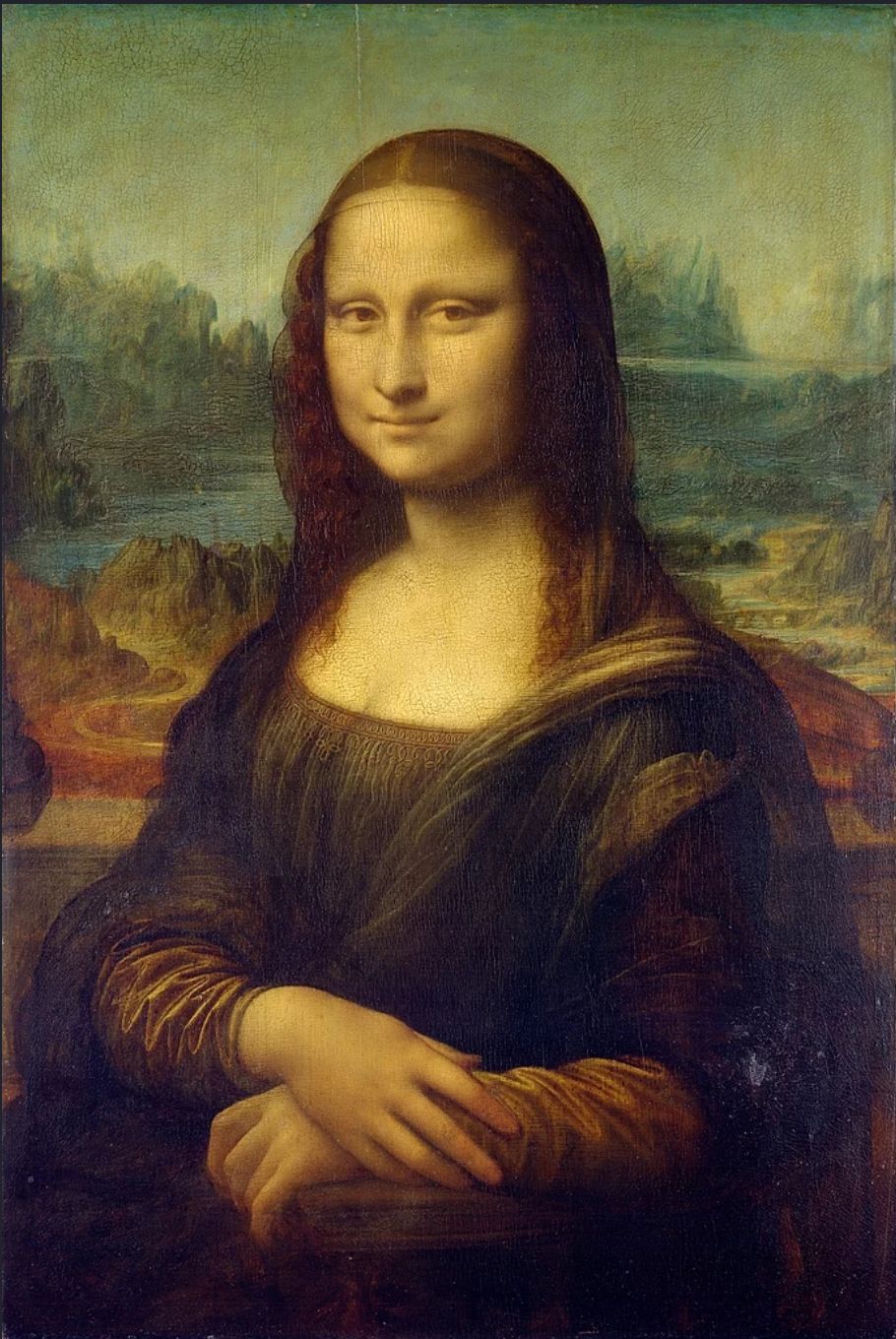
     There’s a related phenomenon in visual depiction: what is “figure” versus what is “ground.” Consider the most famous painting of the Renaissance era: Leonardo Da Vinci’s “Mona Lisa:”

     The conventional interpretation of this portrait is that the “figure” is the woman depicted “front and center,” whereas the “ground” is the landscape depicted behind her. Much attention has been given to the woman’s subtle smile and the details Da Vinci captured in her expression. But were you aware that scholars of the fine arts devote as much attention, if not more, to the backdrop, and the delicacy with which Da Vinci captured its colors and shadings? To such critics the “ground” matters quite as much as the “figure” – and why shouldn’t it?

     That having been said, have a couple of deliberate attempts to confuse the viewer’s eye by making the “figure” and “ground” interchangeable at will:

     The first of these is by noted graphic artist Scott Kim. The second is from that inveterate composer of visual conundrums, Maurits C. Escher. Both eliminate any depicted “preference” for “figure” over “ground,” such that it becomes a matter of what the viewer chooses to see rather than any assertion by the artist.

     Mind you, these are not items you’re likely to have framed and hung on your living room wall. They’re essentially puzzles, or more accurately solutions to a puzzle: how to eliminate any conception of “ground” from a composition. They’re clever and thought-provoking, but very few persons would prize them as decor items.

     “What the hell is he driving at?” I hear you mutter. Well, it’s mainly about fiction: a phenomenon some of my indie colleagues have noticed as they pump out their stuff.


     Every now and then a reader of my fiction will ask why I haven’t tried to produce anything in some sub-genre he favors. In the usual case, my answer is that “it’s been done,” sometimes with a sotto voce “to death” at the end. I dislike to have my name associated with anything formulaic or commonplace; I prefer to be thought of as a writer who boldly goes where no writer has gone before.

     Yet there is this about those “it’s been done” subcategories: They sell like beer at a ballgame in August. Why else would Harlequin be carting bucks to the bank in wheelbarrows? A popular subcategory can make a writer very well to do -- if he can get himself recognized among his competitors. Of course as always, the most important word in that previous sentence is if, but if the premise be fulfilled, the consequence is undeniable.

     (Agents and publishers are well aware of this. I once had an agent who was forever after me to “Write a nice romance, Fran.” Her love of the genre was at least partly because a romance that “catches on” will sell in big numbers. She couldn’t fathom why I kept demurring.)

     With regard to indie versus traditional publication, Sarah Hoyt mentioned an important aspect of this phenomenon:

     I’ve met young, (thirty something) indie authors making a living after 1 year. I’ve looked at and read their (usually fairly short) books, and there is no magic sauce. They read like very young-in-writing authors, who will get better in time. Some of them are eminently readable but I have to turn off the part of my back brain that groans and goes “oh, hey, I used to do that.”

     …. So, what gives?....

     This morning I realized why your traditional career might give you a little boost (or a significant boost) in indie, but it won’t be at the same level starting out. And why even those who have dual careers need to start out again in indie, even while they’re still doing fine (and are sometimes megasellers) in traditional. And also why traditional publishers think the indie market doesn’t really matter and fail to understand the significance of ebooks.

     Are you ready for this? Once you see it, you can’t unsee it: it is because traditional and indie play to fundamentally different sets of readers.

     But what, pray tell, differentiates those sets of readers? Who are the readers gobbling up the emissions of those young-but-successful indie writers and what’s their secret? Sarah will tell you:

     They go by many names from super readers to compulsive readers. To call us — yes, I’m confessing — by our real name, we’re story addicts. The threshold to be one is RIDICULOUSLY low: 3 books a month. I have no clue what they call people who in slow times average three books a week, and when on vacation or otherwise not busy can do that a day, but I know we exist, and I know I’m not alone. (Right, I’m not alone? Right?) We’re the people who sneak a book into the pocket of our formal clothes and panic because you can’t figure out how to sneak a book into your wedding dress. We exist, and we won’t live in the shadows anymore. I mean… ahem… whatever.

     And why should the most financially successful indie writers have hit it big with those “super readers?”

     You see, Indie by its nature, the fact that books are cheap (and a lot of us lunatics are subscribed to Kindle lending library, too) and that they are varied, but mostly THAT THEY’RE IN SERIES and series that are published two to three months apart for new installments, caters to the 5% who buy 80% of the books.

     COMPLETELY different market from traditional. And one about which I can speak authoritatively because, again, I AM THAT market, or a typical member of it.

     If you write anything remotely readable and non offensive in one of our genres or subgenres, (we can now be picky) we will find you and we will read you.

     Now, this is not a uniform characteristic of the “super reader.” I should know; I’m one such. On average I read a novel a day. (Yes, all the way to the end.) The last time I spent an entire week on a single book, the book was Kristin Lavransdatter. But I’m averse to the interminable series, especially if it falls into one of the “it’s been done” subcategories, even though such a series would satisfy my reading addiction better than any standalone novel.

     The reason is the “figure versus ground” phenomenon.


     Within a single story, we may think of the “figure” as the cast of characters and their actions as the story progresses. The setting, and some of the events to which the characters must respond, constitute the “ground.” One approach to a genre / subgenre categorization is to think of it as those characteristics of the “ground” that may (or must) appear in stories in that category. For example, within the genre of fantasy we have the subgenres of medieval fantasy and “urban” fantasy. A story of the former sort is set in a largely nontechnological milieu and will involve magic and / or non-human creatures some of whom have special powers. In contrast, an “urban” fantasy will be set in a milieu that resembles present-day human society. It may involve magic, and it probably will involve paranatural creatures: e.g., vampires, werewolves, zombies. The stories common to those two subcategories differ considerably from one another in style and tone.

     Each subcategory has a large number of dedicated readers. Those readers will read anything in their preferred subcategory if:

  • It’s not too expensive;
  • It doesn’t offend their sensibilities;
  • It’s competently executed: i.e., not too many glaring errors.

     God bless and keep those readers! They’re getting what they want and helping a bunch of indie writers pay the bills. What could be objectionable about that? Nothing I can think of. But I’m not one of them. My immediate reaction to a new book in either of those categories is “it’s been done.”

     The “ground” against which those stories are told is simply too well-trodden for me.


     I don’t write in those too-well-trodden categories for a related reason: Stories in them tend to be less than memorable. The problems characters face in those categories tend to be as well-trodden as the categories themselves. Now and then an innovator will come up with something novel within the category – John Conroe’s “Demon Accords” series is an example – but that possibility attracts me less as a writer than a field with plenty of unplowed ground. I want to write stories the reader will remember for a long time – hopefully not in a “Why did I waste my time and money on Porretto’s crap?” fashion.

     All the same and beyond all dispute, the big revenues are going to the hyper-prolific writers whose works are aimed at a popular subcategory and its addicts. If revenue is his goal, the indie writer should do as those hyper-prolific writers do:

  • Choose a popular subcategory to write within;
  • Invent a few protagonists who can move from one novel to another;
  • Pump ‘em out as fast as possible: thousands of reading addicts are counting on you!

     There’s nothing ethically wrong with this. It’s just one more trade-off. You’ll make money – always assuming you can get noticed in the first place – but your stories won’t stand out or create long-term remembrance in your readers.

     It’s just not for me.


     This piece arose in large part because of the difficulty I’m having completing my novel under construction. I’m a perfectionist; I want every word to be exactly the right one, and every sentence to ring with a rhythm that compels the reader to press onward. That costs a lot of time and effort. Add to it an absolute commitment that this tale shall be one never before told, and you’ve got a formula for slow production.

     So I manage to write about one novel a year. And I don’t make much money. Those are the downsides. But the choice was and is a conscious one. It derives from my scale of priorities, which I have no power to alter. At the top of that scale stands this mandate:

The Ground shall be fresh and fallow;
The Figure shall be new and memorable.

     You pays your money and you takes your choice.

Monday, December 9, 2019

Reasonable Expectations

     When I have occasion to look at one of my own novels, it is sometimes the case that I spot a flaw in what I’ve written. It might be a homophone error, or an extra-word or missing-word error, or perhaps a minor problem in formatting. Whatever it is, the discovery will irritate me greatly, in an “I should be better than that” sort of fashion. The reaction is an expression of my expectations for myself, and the responsibility I feel toward my readers.

     In these days of Independent Publishing Triumphant – and it is triumphant, Gentle Reader; sales of indie fiction now far exceed those of conventionally published fiction – this brings a serious question to mind:

Given that the typical indie writer is a person of modest means who mostly “goes it alone” from story conception to production, editing, packaging, distribution, and promotion, should our expectations of his “error quotient” be somewhat more relaxed than what we would impose on fiction from a conventional publishing house?

     Today’s fictioneer does have better tools at his disposal than a mere typewriter. Moreover, they’re not at all expensive. Some of them are essential to producing a publishable manuscript at all. We can reasonably expect that a writer will use the facilities built into those tools, spelling checkers being at the top of the list. But as anyone who’s ever bruised his fingers against a keyboard can tell you, spelling checkers can miss quite a few kinds of errors. The same goes for grammar checkers. And there are problems of other kinds, including some quite serious ones, whose detection and capture isn’t currently automated.

     Given our awareness that the job is large and demanding and the indie is all alone in doing it, what is it reasonable to expect from him?


     Since I became involved with indie fiction about ten years ago, I’ve read some brilliant, meticulously produced stuff, some unconscionable crap, and a great deal of fiction that stood between those poles. I recall one writer, whose stuff grabbed me by the collar novel after novel, who seemed to disdain proofreading. His stories were incomparably better than their physical instantiation. Errors of every kind in the book could be found on every page of any of his novels. But the originality of his story concepts and the brilliance of their expression got me past those technical flaws.

     Just now I’m working my way – mild emphasis on working — through a military SF series written by an indie whose name you might know. The stories aren’t entirely original; indeed, they fall into a category most readers of that subgenre would have encountered before. They aren’t all that well told, either. The author is low on technique and seems unaware of certain conventions that could have made the books easier to write and easier for the reader to follow. There are also many low-level errors: misspellings, wrong-word errors, missing-word errors, and so forth. (I can’t be any more specific than this without revealing the identity of the writer, whom I do not wish to embarrass.)

     But I’m reading them. I do have to suppress irritation at the errors and poor storytelling technique, but I’m reading them. I find them valuable for their themes, which aren’t the sort the barons of conventional publishing would find appealing. Indeed, the climate of political correctness and rampant leftism that reigns in Pub World would probably get these books rejected without any consideration whatsoever. The central character is something of a role model for the profession of arms: the sort of figure one who aspires to a military career would do well to study.

     Now, while it might be arrogant of me to feel thus, I’ve been itching to volunteer my services to the author as a technique tutor and editor. I have a feeling any such offer would be indignantly rejected; after all, no mother wants to be told her baby is deformed. But the impulse is an expression of the value I find in the works even as they are today. It’s also a gauge for the importance of indie fiction as a conduit for stories and themes the conventional houses are unwilling to consider. There’s a moral in there.


     Sturgeon’s Law, unlike Theodore Sturgeon himself, is alive and functioning in the realm of indie fiction. You have to wade through a lot of garbage to find a jewel...and at that, some of the jewels are semi-precious at best.

     Even so – and believe me, I’m fully aware of how far indie fiction still needs to develop – it’s a field of great promise. Indie is where the originality is. Yes, there’s a lot of hackneyed stuff in the indie orbit: vampires, zombies, space wars, Tolkien derivatives, and other clichés. But the stodginess of the conventional houses is such that hackneyed crap in well-traveled subgenres, easy to categorize and market, is essentially all they’ll publish. Genuinely original fiction has essentially no chance of making it past their gatekeepers. How can we know it will sell? And indeed, that is the crux, for conventional publishers must sell lots of books to meet the bills, whereas the indie is usually under less pressure to do so out of his book revenue.

     So I’m in favor of cutting writers who tell decently original stories with important themes a lot of slack. It’s bit like a taste for moonshine: You can’t get it in the store, so if you want it, you have to be willing to accept a jug without a label or a Surgeon General’s warning on the side. Hell, you might be socially obliged to commune with the vendor over a jelly-jar full of the stuff while he complains about his no-account brother in law, his lazy kids, and how his bunions are just killing him.

     Thoughts?