Showing posts with label originality. Show all posts

Wednesday, August 19, 2020

Writer Reviewing Other Writer’s Books Experiences Great Consternation

     (Film at eleven!)

     Seriously, as a writer with nearly three decades of experience under my belt, it can be very difficult to assess another writer’s work in a fair and evenhanded manner. After all, most readers are not writers themselves – yea verily, even today – and are mainly interested in learning whether they would be likely to enjoy the book in question. If your review doesn’t give them a sense for that, it’s essentially pointless.

     But readers who write approach others’ fiction with a different perspective. Its essence is well expressed in this piece by Writing Observer:

     When a writer reads someone else’s work, unless they are one of the lucky few that can switch off that part of their brain at will, they are simultaneously analyzing the text flowing beneath their eyes. We can’t help it — like any other professional, we are constantly looking for help with our own efforts. What doesn’t work here, and how do I avoid it? What is a beautiful, shiny piece of prose, or scene, or entire chapter, and how do I make mine look so good?

     It’s an uncomfortable feeling — and sometimes a dangerous one. We can lose sight of the forest for the trees, people. We have to cultivate an ability to step back and look at the work as a whole — that is what makes a good (or bad) piece of work, not a few blemishes or a few shining passages. The whole work is what matters in the end...

     A writer who undertakes to review is obliged to remember that any writers who read his review will be heavily outnumbered by ordinary readers looking for a few hours’ entertainment. Any nitpicking he might express to himself about the book in question should be downplayed in favor of an emphasis on the book’s entertainment value.

     An example: Back when Tom Clancy was churning out the techno-thrillers, I purchased, read, and greatly enjoyed virtually all of them. Yet Clancy’s prose is a study in a wide variety of errors young writers are counseled to avoid. Some of those errors are serious: for example, ambiguity of viewpoint and head-hopping in mid-scene. Others are minor glitches of phrasing and style that a multitude of other writers – far less gifted than Clancy at crafting and narrating a compelling story – also commit. But the writer-who-reads and notices them can still be enthralled by the storytelling. If he chooses to review, he’s ethically obliged to keep that uppermost in mind.

     And so we come to my episode of consternation.


     I receive a daily email from Freebooksy that reports on the day’s free-eBook promotions. Now and then I pick up a book from that email. I last did so about a week ago: Emergence, by Liberty Speidel.

     The nitpicky, Uber-perfectionist lobe of my brain was in overdrive from the very first page. There were a lot of stylistic glitches. There was also a revelation that should have occurred but didn’t, as I would find out much later. Main character Darby was portrayed in a fashion that struck me as ambivalent: equally likely to strike a reader as sympathetic or unsympathetic. But the central premises are original, especially considering that the tale is part of the “superheroes” genre, and the plot moved me smartly along. So when I finished Emergence, I went on to Retaliation,the next book in the series.

     Well, the stylistic glitches didn’t trail off. If anything, they increased in frequency. Darby’s characterization continued to be jagged, not always effectively sympathetic. I also deemed one of Speidel’s “structural” choices to be dubious. But there was a sense of freshness about the story’s sociopolitical backdrop and its most important plot motifs. When I finished it, I went directly on to book three, Capitulation.

     I could go on in this vein through books three, four (Omission), and five (Escalation). There were more errors of the sort in the previous books, plus lots of loose ends, and at least one continuity error of note. Perhaps worst, main character Darby was ever more portrayed as headstrong, disrespectful of higher authority and heedless of others’ greater experience, and prone to acting without thinking or pondering the probable consequences – i.e., who struck me as a brat who should be sent to her room without her dinner or cell phone.

     By now you must have the idea. As much as the writer in me wanted to take Speidel across my knee and spank her soundly for her myriad errors of craft, she’d invented a setting of considerable originality, had made use of motifs that were either inherently original or original as employed, and had kept the stories moving forward at a good tempo. How to review the series?

     Great God in heaven! My writerly side kept wanting to chastise Speidel. But I’d read all five books, end to end, without pausing. To write a nitpicky, hypercritical review, as if I were critiquing my own fiction, would unfairly shortchange the entertainment value of the books. Yet not to mention the flaws at all would grate severely against the part of me that values craft and precision in writing.


     I’m still dithering. Perhaps the only place I’ll mention my consternation is right here. (Or at my op-ed site, where this will be cross-posted.)

     I wrote some time ago about the importance of being reasonable in one’s expectations of an indie writer, especially a relatively inexperienced one. I still feel that way. So if and when I get around to actually posting a review of Speidel’s “Darby Shaw” series, I’ll have to rein in the impulse to harp on what I saw as failings of craft and emphasize the entertainment value the series offers. Ordinary Christian charity would dictate that course. For now, the above emission of steam should bring the pressure down to a manageable level.

Saturday, March 28, 2020

"The Same, But Different"

     I’d say there are plenty of writers blathering on about the Wuhan virus, our overreaction to it, and the political foofaurauw over it, wouldn’t you, Gentle Reader? So I’m going to deviate. Of course, what I’ve chosen for today’s topic might prove even less appealing, but that’s a risk you’ll simply have to take. Just remember to wash your hands frequently, drink plenty of fluids – I recommend Harvey’s Bristol Cream Sherry – and refrain from kissing random strangers, and you should be all right.


     First, The Warm Lands has already received a few positive reviews, though I could always use a few more, hint hint. The most striking of the official ones comes from my treasured colleague Margaret Ball:

     No Quest. No Chosen One. No adolescent discovering mysterious powers. No oracular ancient prophecies. And no magical MacGuffin... is this really a fantasy novel? Yes, and it brings a delightfully original take to a field in which too many of those elements have become virtually de rigueur. In a departure from his usual near-future science fiction works, Francis Porretto gives us strong and intriguing characters in a fantasy world with some surprising problems and even more surprising solutions. If I have any caveat, it’s only that the fascinating world of the Scholium is not always described in as much detail as I’d like. But one can always hope that future books will delve more into the Scholium and the Great Waste .

     That was very pleasant to read – and by the way, if you like genuinely original fantasy and science fiction, be sure to read Margaret’s stuff. I particularly recommend her Applied Topology, Language of the Dragon, and Harmony series. She and I share an affinity for departing from overly well-traveled paths, which made my discovery of her stuff a true delight.

     However, a statement from one other “reviewer” – my wife Beth, who was a large part of the reason I wrote the novel – has seized my attention in a rather immediate way:

“This is your best book yet.
There had better be a sequel.”

     And after some cogitation about how I could extend the ideas and conflicts without repeating myself, and a review of the various ways life with a disappointed wife could become...unpleasant, I have decided that a sequel there shall be. Probably two, in fact.

     Yeesh. So there’ll be yet another fantasy trilogy out there. Oh well. I doubt the prospect will cost Tolkien’s heirs any sleep.


     The title of this piece is one version of an editorial mantra that has tremendous force in conventional publishing houses (a.k.a. Pub World). It arises from the terrible difficulties publishers have in predicting what will sell. A business must succeed in selling its products to remain in business, and publishers know from history that most of what they put out will not “break even:” i.e., the revenues for most of their books will fail to equal (much less exceed) the aggregate costs of acquisition, production, promotion, and distribution.

     So publishers’ editors look for any indications whatsoever that a submission might sell profitably. There aren’t many such. The most reliable of all is the author’s name. If he’s well known and has a loyal following of adequate size, his latest book is a good bet. But of course, most submissions don’t come from the Stephen Kings and Tom Clancys of the world.

     The next most significant indicator is whether the submission resembles something that has sold successfully – and sufficiently so that it can be promoted to the readers of that previous success. Of course, the submission must not be identical to the successful book. However, the similarities must be marketable:

  • The same genres;
  • Comparable styles;
  • Comparable structures;
  • Perhaps some shared elements and motifs.

     ...all while maintaining sufficient differences from the predecessor to avoid being called an imitation. This is the publishing desideratum expressed by the mantra “the same, but different.”

     It’s also the reason genuine originality is more easily found among the offerings of indie writers than among those of conventional publishers.


     While I’ve harped on originality as a virtue, I must also admit that it has its downside. Most original ideas fall flat, in fiction as elsewhere. The writer determined to strike out on a completely untraveled path is taking a big chance. He might not click with any significant community of readers. So it takes a degree of daring – to say nothing of an adequate income stream from other sources – to put many weeks or months of effort into composing a tale that’s a true departure from all that’s gone before.

     For readers, too, have their expectations. That’s the reason for genre categorization. As the saying goes, some want elves, others want ray guns, and still others want trans-temporal interspecies sex. (You didn’t know that was a saying? I can’t imagine why not.) That’s a large part of the explanation for the arguments over genre hybridizations such as SF romance.

     So the fledgling writer, contemplating the architecture and key elements of his new novel, has to decide on his level of risk tolerance. He’s about to invest a lot of time and energy in something that might not produce a return. Should he “follow his passion” and boldly go where no novelist has gone before, or should he “play it safe” until he’s established himself as a reliable purveyor of entertainment worth its purchase price?

     It’s a tough call, and no mistake. I’ve certainly struggled with it. I can’t imagine that other indies have found the nut any easier to crack. There are so many of us that getting even a little attention from adventurous readers – persons willing to take a chance on an inexpensive novel from someone they’d never heard of before – is a major challenge. It’s why book giveaways, which eliminate all risk from a potential reader’s acceptance of the book, are popular promotional tools.

     But that publishers’ mantra can be of service. You want to get established before you start defying the norms with your brain-twistingly original concepts? If you find it congenial, pick a hot sub-genre and start by writing something that fits in it. Balance the chance that it will please readers who love that category against the possibilities that the category is already overcrowded, or that your book will be dismissed as “just an imitation of the great Harry Glumph.”

     Most important, resolve to stay rigidly within your chosen sub-genre. Don’t introduce cyclotrons into your medieval fantasy. No ray guns in your Regency romance. Save that for when you’re a household word.

     Publishers’ editors aren’t stupid, after all. If you desire fame and fortune, you might do well to use a little of what they already know from long and dreary experience. Not that there are any guarantees, of course!

Saturday, February 29, 2020

New Directions

     I’ve railed so frequently, and with such vehemence, against unoriginality in speculative fiction – specifically, the endless reuse of worn-out tropes and motifs as the foundation for a novel – that by now my Gentle Readers probably shrink away from the monitor at the hint of a new one. I can easily understand it. Anything repeated sufficiently often will become monotonous, drained of meaning and impact. That would, of course, include the screechings of narrow-gauge sociopolitical commentators who also flatter themselves that they can tell a decent story.

     But hey, a guy’s gotta have a hobby!


     A few months ago, a nonsensical old mantra of the Sixties and Seventies New Left weighed in upon me with disturbing force:

“If you’re not part of the solution,
You’re part of the problem.”

     I can’t explain it, but that phrase – which, in a sociopolitical context, is false nearly all the time – persisted in my thoughts for several days running. I had to ponder it explicitly, with application to the various things I write, to get any peace from it. What problems do I regularly rant about, here or elsewhere? And what solutions, whether of my own proposition or formulated by others, might apply?

     Its pertinence to my sociopolitical commentary briefly eluded me, but once I’d pinned its wings, it pointed me in a new direction: new for me, that is. What, after all, is the prevailing tenor among commentators and pundits? What characteristics does my blather share with them that could make us seem repetitive, unoriginal...boring?

     That’s right: we all talk incessantly about federal politics, and we all take ourselves and our emissions much too seriously.

     Since then, I’ve striven to “lighten up.” I still get drawn into commenting on federal politics much too often – as it’s a quadrennial year with lots of weird goings-on in D.C. and across the nation, it’s a tough lure to resist – but I’ve been trying to be more lighthearted about it. I’ve tried to introduce more humorous material, and to achieve a more humorous approach even to the more serious subjects in the news. The progress has been slow, but changing my lifelong orientation – i.e., as a humorless academic – was bound to take time.

     But it’s in application to my fiction writing that the notion struck home most powerfully.


     I’ve tried my hand at several genres:

  • Contemporary spiritual fantasy;
  • Near-future science fiction;
  • Far-future science fiction;
  • Family saga;
  • Romance;
  • Erotica.

     In each case I’ve tried to do something other writers have not done, or have done so poorly that they might as well not have tried. Whether I’ve succeeded in telling an arresting tale worth its purchase price is for the reader to decide. However, whether I’d managed to deviate significantly from the paths worn smooth by the Thundering Herd of Hacks, Inc. (THH on the NYSE) was my own evaluation to make. In the main I’ve been satisfied, despite modest sales. If I haven’t blazed a wholly new trail, at least (I told myself) I’d found an interesting side track.


     A great part of the reason genuine originality is a risky business is the preference of most readers for something that won’t defy all their preconceptions and developed tastes. For example, while a reader who’s acquired a taste for “hard” (technologically oriented) science fiction is unlikely to be pleased by “soft” (sociologically oriented) SF, he’s likely to be displeased if not offended by a novel billed as hard SF but that shoves its tech elements off to the side in favor of some other focus. Such a reader wants the categorizations to be trustworthy, for he intends to stay within them.

     Yet it is in such crossbred, category-defying stories that one of the paths toward originality lies. Now, there are paths of that sort that I’d advise even the most adventurous writer to avoid: e.g., zombie romance. But even something that absurd deserves at least a glance before shying away in horror (quickly or slowly according to the kind of zombies involved).

     Deviations of another kind are possible, too. Consider “high” fantasy. Such a fantasy usually features magic and wizards or sorcerers who can wield it. It will also tend to omit technology from its setting: a reasonable choice, as a setting in which magic can be used to set the laws of Nature at naught would have little incentive to develop technology as we understand it. There’s a humorous passage from one of Roger Zelazny’s marvelous stories of Dilvish, the Damned to that effect:

     “Tricky,” he said as they moved. “One day they will invent names for the properties of objects, such as the tendency of a thing to move once it is placed in motion.”
     “Of what use would that be?” Reena asked. “Everybody already knows that that’s what happens.”
     “Ah! But one might put numbers to the amount of material involved and the amount of pushing required, and come up with wondrous and useful calculations.”
     “Sounds like a lot of trouble for a small return,” she said. “Magic’s a lot easier to figure.”

     [From “Tower of Ice”]

     Some adventurous writers have explored a technological or semi-technological side trail. Craig Allen’s excellent Beyond the Sky is a striking example. Margaret Ball’s delightful The Language of the Dragon is another. And of course we have the late, great Poul Anderson’s Operation Chaos stories at the far end: told in a setting fully as technological as present-day America, but also equipped (or burdened, if you prefer) with magic and supernatural conflict. Such stories won’t appeal to everyone, but that’s always a hazard when one is determined to try something offbeat.


     I’m on the verge of releasing an unusual fantasy novel. Its setting is pre-technological. Sorcery is the tale’s dominant operational motif. But the crisis motif is essentially ecological. The overuse of magic, in an age long past, produced a Dieback that destroyed nearly all life, depopulated the world, and left the surviving pockets of Mankind isolated from one another by a Great Waste. While the Waste can be crossed by one sufficiently well prepared, it’s not for the faint of heart. It’s the central task of the sorcerers of that time and place to bring about the re-greening of the world. But they must overcome unique and significant opposition.

     I was reluctant to attempt this novel, but eventually I decided that as a fresh entrant in a field dominated by “quest” stories in the Tolkienian vein, it would be worth the effort. It should be out in a week or so; just now I’m waiting for a proofreader — Margaret, Linda, are you reading this? — to give it the hairy eyeball. Will it appeal to the typical reader of “high” fantasy, accustomed to the quest-schematic Tolkien, Brooks, and their many imitators have followed? No way to know.

     But it’s a thrust in a new direction. If it proves popular, it could result in the emergence of a schematic of its own. At any rate, it’s something un-ordinary. It cost me agonies in the crafting, but I can honestly say it’s my own and not an imitation of someone else’s tale. For me, that is sufficient.

     Have a nice day.

Thursday, January 2, 2020

Figure And Ground

     An engineer facing a communications related problem must resolve one distinction before all else: what is “signal” versus what is “noise.” In layman’s terms, “signal” is your attempt to say something to your interlocutor or vice versa. “Noise” is anything and everything that competes with the “signal” and therefore must be excluded from your attention. Of course, context matters. In a conversation in a crowded, noisy restaurant, “signal” is your voice or that of your interlocutor, whereas “noise” is any other sound, including other diners’ conversations, that the two of you are straining to ignore. If you can’t distinguish them, you can’t communicate.

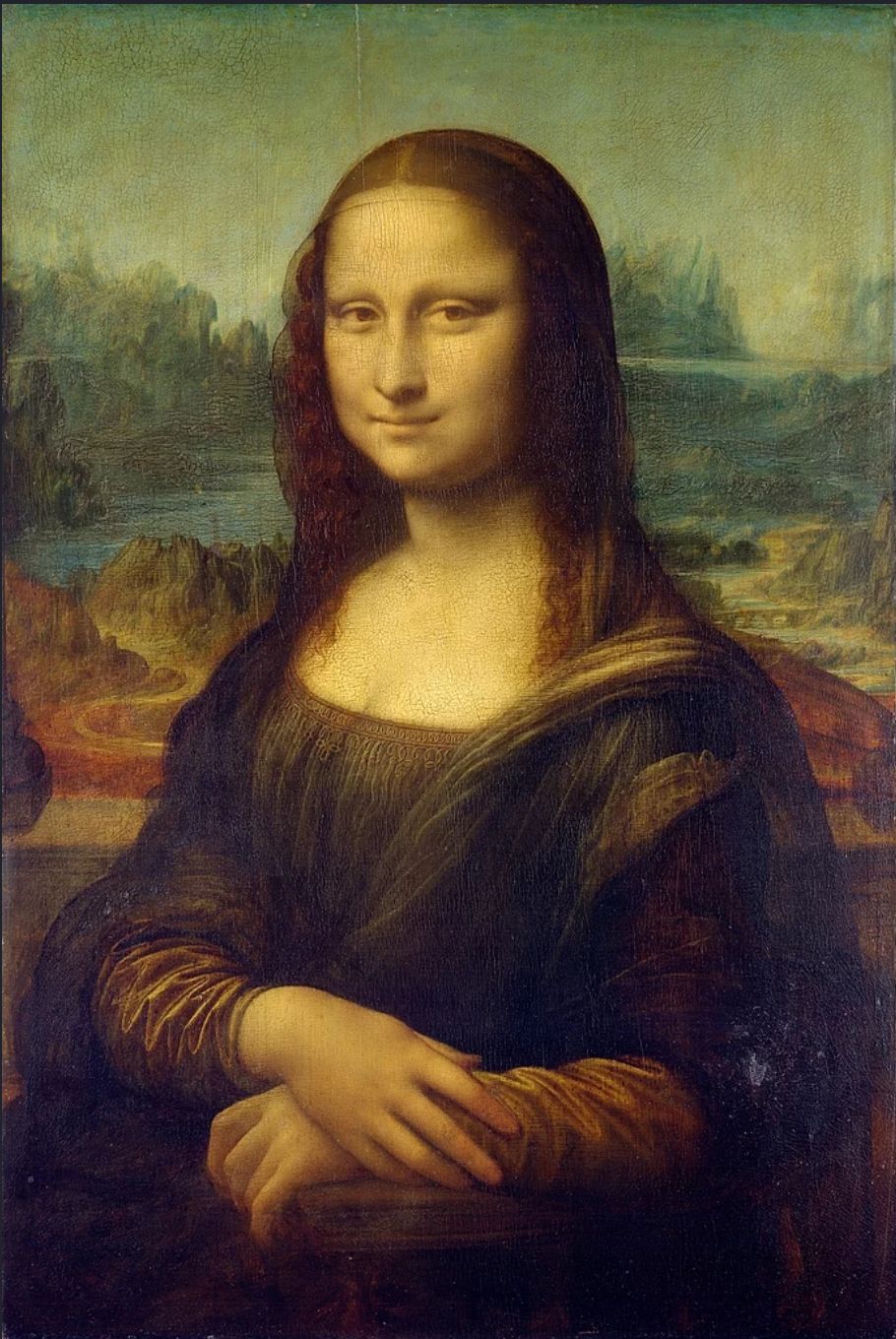
     There’s a related phenomenon in visual depiction: what is “figure” versus what is “ground.” Consider the most famous painting of the Renaissance era: Leonardo Da Vinci’s “Mona Lisa:”

     The conventional interpretation of this portrait is that the “figure” is the woman depicted “front and center,” whereas the “ground” is the landscape depicted behind her. Much attention has been given to the woman’s subtle smile and the details Da Vinci captured in her expression. But were you aware that scholars of the fine arts devote as much attention, if not more, to the backdrop, and the delicacy with which Da Vinci captured its colors and shadings? To such critics the “ground” matters quite as much as the “figure” – and why shouldn’t it?

     That having been said, have a couple of deliberate attempts to confuse the viewer’s eye by making the “figure” and “ground” interchangeable at will:

     The first of these is by noted graphic artist Scott Kim. The second is from that inveterate composer of visual conundrums, Maurits C. Escher. Both eliminate any depicted “preference” for “figure” over “ground,” such that it becomes a matter of what the viewer chooses to see rather than any assertion by the artist.

     Mind you, these are not items you’re likely to have framed and hung on your living room wall. They’re essentially puzzles, or more accurately solutions to a puzzle: how to eliminate any conception of “ground” from a composition. They’re clever and thought-provoking, but very few persons would prize them as decor items.

     “What the hell is he driving at?” I hear you mutter. Well, it’s mainly about fiction: a phenomenon some of my indie colleagues have noticed as they pump out their stuff.


     Every now and then a reader of my fiction will ask why I haven’t tried to produce anything in some sub-genre he favors. In the usual case, my answer is that “it’s been done,” sometimes with a sotto voce “to death” at the end. I dislike to have my name associated with anything formulaic or commonplace; I prefer to be thought of as a writer who boldly goes where no writer has gone before.

     Yet there is this about those “it’s been done” subcategories: They sell like beer at a ballgame in August. Why else would Harlequin be carting bucks to the bank in wheelbarrows? A popular subcategory can make a writer very well to do -- if he can get himself recognized among his competitors. Of course as always, the most important word in that previous sentence is if, but if the premise be fulfilled, the consequence is undeniable.

     (Agents and publishers are well aware of this. I once had an agent who was forever after me to “Write a nice romance, Fran.” Her love of the genre was at least partly because a romance that “catches on” will sell in big numbers. She couldn’t fathom why I kept demurring.)

     With regard to indie versus traditional publication, Sarah Hoyt mentioned an important aspect of this phenomenon:

     I’ve met young, (thirty something) indie authors making a living after 1 year. I’ve looked at and read their (usually fairly short) books, and there is no magic sauce. They read like very young-in-writing authors, who will get better in time. Some of them are eminently readable but I have to turn off the part of my back brain that groans and goes “oh, hey, I used to do that.”

     …. So, what gives?....

     This morning I realized why your traditional career might give you a little boost (or a significant boost) in indie, but it won’t be at the same level starting out. And why even those who have dual careers need to start out again in indie, even while they’re still doing fine (and are sometimes megasellers) in traditional. And also why traditional publishers think the indie market doesn’t really matter and fail to understand the significance of ebooks.

     Are you ready for this? Once you see it, you can’t unsee it: it is because traditional and indie play to fundamentally different sets of readers.

     But what, pray tell, differentiates those sets of readers? Who are the readers gobbling up the emissions of those young-but-successful indie writers and what’s their secret? Sarah will tell you:

     They go by many names from super readers to compulsive readers. To call us — yes, I’m confessing — by our real name, we’re story addicts. The threshold to be one is RIDICULOUSLY low: 3 books a month. I have no clue what they call people who in slow times average three books a week, and when on vacation or otherwise not busy can do that a day, but I know we exist, and I know I’m not alone. (Right, I’m not alone? Right?) We’re the people who sneak a book into the pocket of our formal clothes and panic because you can’t figure out how to sneak a book into your wedding dress. We exist, and we won’t live in the shadows anymore. I mean… ahem… whatever.

     And why should the most financially successful indie writers have hit it big with those “super readers?”

     You see, Indie by its nature, the fact that books are cheap (and a lot of us lunatics are subscribed to Kindle lending library, too) and that they are varied, but mostly THAT THEY’RE IN SERIES and series that are published two to three months apart for new installments, caters to the 5% who buy 80% of the books.

     COMPLETELY different market from traditional. And one about which I can speak authoritatively because, again, I AM THAT market, or a typical member of it.

     If you write anything remotely readable and non offensive in one of our genres or subgenres, (we can now be picky) we will find you and we will read you.

     Now, this is not a uniform characteristic of the “super reader.” I should know; I’m one such. On average I read a novel a day. (Yes, all the way to the end.) The last time I spent an entire week on a single book, the book was Kristin Lavransdatter. But I’m averse to the interminable series, especially if it falls into one of the “it’s been done” subcategories, even though such a series would satisfy my reading addiction better than any standalone novel.

     The reason is the “figure versus ground” phenomenon.


     Within a single story, we may think of the “figure” as the cast of characters and their actions as the story progresses. The setting, and some of the events to which the characters must respond, constitute the “ground.” One approach to a genre / subgenre categorization is to think of it as those characteristics of the “ground” that may (or must) appear in stories in that category. For example, within the genre of fantasy we have the subgenres of medieval fantasy and “urban” fantasy. A story of the former sort is set in a largely nontechnological milieu and will involve magic and / or non-human creatures some of whom have special powers. In contrast, an “urban” fantasy will be set in a milieu that resembles present-day human society. It may involve magic, and it probably will involve paranatural creatures: e.g., vampires, werewolves, zombies. The stories common to those two subcategories differ considerably from one another in style and tone.

     Each subcategory has a large number of dedicated readers. Those readers will read anything in their preferred subcategory if:

  • It’s not too expensive;
  • It doesn’t offend their sensibilities;
  • It’s competently executed: i.e., not too many glaring errors.

     God bless and keep those readers! They’re getting what they want and helping a bunch of indie writers pay the bills. What could be objectionable about that? Nothing I can think of. But I’m not one of them. My immediate reaction to a new book in either of those categories is “it’s been done.”

     The “ground” against which those stories are told is simply too well-trodden for me.


     I don’t write in those too-well-trodden categories for a related reason: Stories in them tend to be less than memorable. The problems characters face in those categories tend to be as well-trodden as the categories themselves. Now and then an innovator will come up with something novel within the category – John Conroe’s “Demon Accords” series is an example – but that possibility attracts me less as a writer than a field with plenty of unplowed ground. I want to write stories the reader will remember for a long time – hopefully not in a “Why did I waste my time and money on Porretto’s crap?” fashion.

     All the same and beyond all dispute, the big revenues are going to the hyper-prolific writers whose works are aimed at a popular subcategory and its addicts. If revenue is his goal, the indie writer should do as those hyper-prolific writers do:

  • Choose a popular subcategory to write within;
  • Invent a few protagonists who can move from one novel to another;
  • Pump ‘em out as fast as possible: thousands of reading addicts are counting on you!

     There’s nothing ethically wrong with this. It’s just one more trade-off. You’ll make money – always assuming you can get noticed in the first place – but your stories won’t stand out or create long-term remembrance in your readers.

     It’s just not for me.


     This piece arose in large part because of the difficulty I’m having completing my novel under construction. I’m a perfectionist; I want every word to be exactly the right one, and every sentence to ring with a rhythm that compels the reader to press onward. That costs a lot of time and effort. Add to it an absolute commitment that this tale shall be one never before told, and you’ve got a formula for slow production.

     So I manage to write about one novel a year. And I don’t make much money. Those are the downsides. But the choice was and is a conscious one. It derives from my scale of priorities, which I have no power to alter. At the top of that scale stands this mandate:

The Ground shall be fresh and fallow;
The Figure shall be new and memorable.

     You pays your money and you takes your choice.

Monday, July 29, 2019

Short Cuts And Long Delays

     When I embark on a new novel-project, I’m usually tempted to look for a short cut, a quick way to “get into” the effort. Sometimes I find one. Sometimes it’s suitable. More often, it proves to be a detriment, though that might not be obvious for some time.

     The kind of temptation that’s proved least destructive to the ultimate creation is the substantial fund of short stories I’ve written over the decades, some of which prove extensible, with enough thought and effort. Love in the Time of Cinema emerged from such a story, and I’d say it worked out well. But needless to say, not all short tales lend themselves to being used in that fashion. I’m working on and with one such today, and it’s been giving me fits.

     The most destructive temptation – and I’m pleased to be able to say that it’s one I’ve successfully resisted – is the one that whispers “Just borrow this idea, add a couple of characters and a few grace notes, and call it your own!” It’s not necessarily plagiarism to do so; the narrative archetypes are few, and their skeletons can be detected in every decent story ever written. But unless he can come up with an original motif or two and frame the story around them, the writer cannot honestly call the tale his own creation.

     Yet innumerable writers copy well-trodden paths, add nothing significantly original or fresh, and publish the results. That’s the prevalent practice in fantasy today, especially “urban” fantasy. I have little respect for such “creators.” I disdain to read their “creations,” once I can discern their lineaments. But many of them are far more successful in dollars-and-cents terms than I.

     In all fairness, it’s extremely difficult to remain within the confines of a long-established, strongly patterned genre yet produce something genuinely new. The difficulty romance writers have with it gave birth to the Harlequin line, which recycles a publication back to pulp after it’s been on the shelves for a single month. The grooves are too deep. They admit of too little innovation. Such books appeal directly to the reader who wants to keep reading “my favorite story” over and over and OVER.

     The “short cut” available from such a strong, innovation-averse pattern can result in a long delay in a writer’s maturation – and no, I don’t mean “finding his voice.”


     The late Isaac Asimov, when asked the most common of all fan questions – “Where do you get your ideas?” – replied that story ideas are all around us; just reach out and grab one. They practically attack the attentive writer, for a simple reason: they’re about people struggling with problems. Usually they’re problems of the sort people have always had.

     If you’ve been reading my stuff for a while, you’ve seen these before:

John Brunner’s Laws Of Fiction:
1. The raw material of fiction is people.
2. The essence of story is change.

     People’s problems are about the challenges they face and must surmount: from their surroundings, from their personal limitations and inhibitions, and (of course) from other people. Some problems are too trivial to produce drama – to the best of my knowledge, “He needed a clean pair of briefs and didn’t have one!” has never inspired any writer to greatness in storytelling – but there are innumerable ones that writers have used to evoke drama, heroism, and the reader’s sense of the breadth and depth of human existence. Even a barely educated person will be familiar with many such problems and their fictional exploitation.

     In a way, the reason for the speculative genres – fantasy, science fiction, and horror – is that they allow the imaginative writer to shed new light on a classic problem. Consider the problem of survival. While there’s still ample room for stories of survival against great odds in the here and now, the unique moral-ethical cast it can acquire from a science fiction setting can enable it to stimulate readers who might never have considered its complexities. Perhaps the problem is how to defend an innocent against a predator, or a predatory force. A technological motif can make such a contest vivid in a way tales of Mafia dons or serial killers cannot. Possibilities abound; reach out and grab one!

     Some short cuts can be useful as a “leg up” to prominence. For example, now and then, a precast setting, created by a successful writer, is offered to other, less well known writers as an environment in which to tell a tale and gain an expanded readership. This has become fairly common in the speculative genres. Larry Niven’s “Man-Kzin Wars” anthologies are a good example, as are George R. R. Martin’s “Wild Cards” collections. On August 6, military SF writer Tom Kratman will release an anthology of that sort, centered on his imagined colony world of Terra Nova. Our beloved Co-Conspirator Dystopic/Thales (he uses both monikers) will have a story therein, so don’t miss it. But such supports should not be regarded as reliable in perpetuity; to mature and earn personal distinction, a writer must strike out on a path he can justly call his personal creation.


     “Short cuts make long delays,” saith John Ronald Reuel Tolkien. He would surely know. If you aspire to write fiction, be aware of the dangers inherent in mimicry. It can trap you as surely as quicksand, and to the same ultimate effect. A leg up here and there is one thing; walking slavishly and undeviatingly in the footsteps others have left is another. The only way to become a writer others will respect – and I don’t necessarily mean other writers, but I don’t necessarily not mean them, either – is to create your own brand from the fertile if tangled resources of your imagination, experience, and heart.

     Get busy.

Monday, July 8, 2019

Story Recipes

     I’ve made such an obsession out of originality that at times I can blind myself to the possibilities that could arise from a different perspective.

     No, I’m not talking about exploiting the enormous commercial possibilities from hopping onto one of the current “hot” bandwagons and showing the world what a real storyteller can do with it. What I have in mind is more what a creative cook does when he seeks a new approach to the preparation of some basic item.

     Even the most creative cooks don’t invent entirely new ingredients. They work with what God has given us: the minerals, plants, and animals that already inhabit the Earth. They look for new combinations of those things that might prove pleasing to the palate. I have no doubt that an adventurous cook would need to discard the results of many unsatisfactory experiments...always assuming he didn’t face the severe choice of eating them himself or starving to death. But when he finally hits on something both new and genuinely pleasant, he presents it to the world with pride as his creation. It is legitimately his even though, as with “the figure in the marble” a sculptor seeks to reveal with his chisel, it was always there to be found by anyone sufficiently determined to seek it out.

     Recently there have been some impressive breakthroughs of this sort. E. William Brown’s “Daniel Black” and “Alice Long” novels come to mind, as do Margaret Ball’s “Center for Applied Topology” series and her recent novel Salt Magic. The “atomic” elements that underpin those creations have been around for a while, but the way Brown and Ball assembled them, in each case previously untried, made them into something new and fresh – i.e., original.

     By contrast, I rack my brain for completely original “atomic” ideas around which to craft my stories. As that organ already has sixty-seven years of wear and tear on it, it doesn’t produce such things simply for the asking. It involves a process that takes time and the convergence of a variety of stimuli (usually including copious amounts of port or sherry). All the same, now and then I find one, and – wonder of wonders! — it manages to sustain a tale. To those who’ve wondered why my books are so widely spaced in time, that’s half the answer; the other half is the agonizing difficulty, as Ernest Hemingway once put it, of “getting the words right.”

     Since the release of The Wise and the Mad, which concludes the “Futanari Saga,” I’ve been casting about for another genuinely new idea, something that would take me in a completely new direction. I haven’t found one, and it’s been giving me fits. At intervals I’ve wondered whether I might have shot my wad. So as of yesterday evening, the pain from that frustration, liberally sauced from a freshly opened bottle of Villa Bellangelo’s exquisite “Elizabeth” port, has me thinking about the “recipe” approach instead.


     J. R. R. Tolkien’s The Lord of the Rings, considered to be the bedrock for fantasy of its kind, was actually derived from the Arthurian legend, albeit with a twist. King Arthur had his magical artifact – Excalibur, “the sword of power” – and a villain to defeat: Mordred, the son of Arthur’s half-sister Morgawse, who desired the throne of Britain for his own. Tolkien adapted the Arthurian pattern by exchanging Excalibur, a weapon loyal to Arthur’s hand, for the One Ring, a wholly malevolent creation of Sauron.

     Because Tolkien worked with a richly imagined world with an intricate backstory, populated by a variety of creatures with special characteristics, the relative simplicity of his “plot drivers” was no impediment to the telling of a long, persistently gripping story. The combination of those drivers with that elaborate backdrop, largely derived from Catholic theocosmogony, and with Tolkien’s gifts for storytelling made his tale a new creation that’s enthralled readers for decades. It continues to be the iconic work in its genre, against which all other works of “high” or medieval fantasy are judged.

     C. S. Lewis wanted to spin a tale from the Arthurian loom but wanted to emphasize the Christian elements and set it in modern Britain. His Space Trilogy has some explicitly Arthurian elements, notably his use of Merlin as a character in That Hideous Strength and his elevation of his protagonist Dr. Elwin Ransom to “Pendragon of Logres,” Logres is an ancient name for Britain in the Arthurian tales. Lewis transformed it into a mystical society whose function is to keep political Britain on the moral straight and narrow. Note, however, that the revived Merlin takes the place of Excalibur as the critical magical “artifact.”

     The patterns these two master talespinners created from Arthurian elements are so compelling that the great majority of their successors in the realm of “high” fantasy have proved unable to depart from them. There have been a few exceptions, notably Orson Scott Card’s “Alvin Maker” series. However, the Arthurian / Tolkienian pattern continues to exhibit a tractor-beam-like effect on writers who approach “high” fantasy today. It suggested to me that the vein might be “played out”...or it did until this very morning.


     I resisted suggestions that I try fantasy until I had the inspirations that produced a handful of short stories: “The Object of His Affection” and “The Warm Lands,” my two magic-based fantasies, and “Foundling” and “Class Action,” my two vampire stories. Paradoxically, these relatively minor expositions are more popular with my readers –i f I go by email feedback, at least – than all the rest of my fiction taken together. I’ve received many, many requests for continuations and “sequels” in each of those “worlds”...and have been unable to produce them. The original ideas in them fought being extended into longer tales, and I could not find new ideas that would supplement them compatibly.

     But as of this morning, owing to the cooking analogy from the first segment, one of those tales has gripped me afresh. I’ve found ways to combine well-worn elements used by other writers to create a wholly new “recipe.” At least, I can’t think of any existing work that follows the pattern I have in mind. So with dedication, perseverance, and a spot of luck, some, at least, of those aforementioned vainly importuning readers will have something to gratify their yearnings, later this year or early in 2020. Beyond that, deponent sayeth no more...for the present!

Sunday, October 21, 2018

Quickies: In Search Of An Idea

     (Leonard Nimoy, call your office!)

     As I await my cover artist’s creation, I’ve been maundering over what to do next fictionally. The Onteora Canon, as much fun as it’s been, deserves a rest, possibly a permanent one. Concerning the Spooner Federation Saga, with which I’ve had an equally good time (and which deserves at least one more novel), I haven’t quite worked up the energy for another volume in that especially taxing series. And I think I need to be away from Athene Academy and the futanari of Onteora County for a little while, for similar reasons.

     But I dislike idleness. To pause for a week or two after completing a novel-length story is one thing; to go on a months-long sabbatical away from fiction is quite another. Dangerous. I could lose my fictioneering chops and be relegated to nothing but these interminable op-eds for the rest of my days. So I’ve been casting about for a fresh idea that would sustain a novel-length story.

     Well, Our Lord and Savior has told us to pray for what we need, so this morning before Mass I asked Him – and His Dad and The Spook, of course – for an idea that would be:

  • Suitable for a novel-length story;
  • Usable in a fantasy or science fiction setting;
  • Relevant to contemporary discourse on a subject of interest.

     And glory be! I got one.

     What’s of greater current interest than ecological balances, eh? Damned near nothing I can think of. Perhaps the most contentious issue within that envelope would be the role of Man in the Terrestrial ecology. the loudest voices are those that proclaim that Man is an excrescence upon Earth’s ecology: an intruder who can only do harm, and whose effects we are morally obligated to minimize.

     But there are arguments, good ones, to the effect that the reverse is true: that Man is an integral part of the ecology, and that his subtraction from it would give rise to what any objective observer would call catastrophe... that is, if there were an objective observer around after Man had been removed from the scene.

     Now, in our temporal reality we would look for destructive organisms and pernicious influences that would surge beyond control without Man to moderate them. But a spec-fic approach would not be restricted to what know of Earth in reality.

     Larry Niven, Steven Barnes, and Jerry Pournelle turned in a nice treatment of this idea in The Legacy of Heorot and sequelae. But that hasn’t used it up. There’s room for further exploration of the idea. A significant departure might include non-biological interactors with a planetary ecosystem: interactors that only Man can control.

     I’ll be tossing this around for a few days, I’m sure.

Saturday, August 26, 2017

“It’s Been Done.”

     Among my memories – some of which are bolstered by the relevant artifacts – I treasure a record titled When You’re In Love The Whole World Is Jewish. It’s a collection of skits on Jewish themes, every last one of which is sidesplitting. The one I have in mind this morning involves a successful businessman named Leibowitz whose son is about to have his Bar Mitzvah. He’s looking for a spectacle that will outdo what a partner did for his son. When a “Bar Mitzvah consultant” suggests that the son read his Bar Mitzvah address before the General Assembly of the United Nations, Leibowitz considers it briefly, then demurs thus: “Not bad, but there’s something missing. I got a feeling it’s been done.”

     Here’s the skit, and just try to control yourself:

     Now that that’s out of the way...

     I’ve become an absolute beast about unoriginality in fiction, especially fiction in the speculative genres: science fiction, fantasy, and horror. The whole point of the speculative genres is to enable the writer’s imagination to roam freely. A writer who elects to mimic someone else’s ideas is wasting the opportunity. A writer who slavishly follows a “hot trend” – e.g., vampire fiction, which has become so obnoxiously repetitive that I refuse to enter a room that contains an item of vampire fiction – has pawned his writer’s gift for a mess of pottage.

     This is giving me some difficulty – steadily increasing difficulty, it seems – with finding reading material. Most of what’s called “mainstream fiction” is terminally boring. The thriller genre is even more repetitive than the speculative ones. And no one’s done convincing military fiction since Tom Clancy and Ed Ruggero.

     Throw in the contemporary tendency among fiction writers to produce series instead of stand-alone novels, and the hunt for something fresh and new becomes torture.

     Among the writers I most enjoy today is Lee Child, the creator of ex-military cop Jack Reacher. Yet Child, too, is beginning to have trouble coming up with fresh crises and conflicts for his nomadic hero to solve. It’s a tough sort of trap from which to free oneself. That’s one of the reasons I’ve been sealing off the ends of the two series I created: I’d rather not get so covered with their adhesive that I can’t come up with something wholly original.

     I’ve emitted plaints like this before. But just now I’ve got nothing new to read, and having just returned from a fruitless search of the recommendations at Amazon, the urge was upon me to vent once more. So, fellow indie writers and would-be writers: what have you got for me that hasn’t been done? I’m a hungry reader with time on my hands, I have a large fiction budget, and I’m waiting!